
The Durham County Clerk of Superior Court
North Carolina elects one clerk in each county to run court records, and that office is called the Clerk of Superior Court. The current Durham County Clerk of Superior Court is Aminah M. Thompson. The office is elected to a four-year term. It is not a county clerk and not a district clerk. North Carolina uses one statewide court system, so a single elected clerk keeps the files for both the District Court Division and the Superior Court Division in Durham County.
The work of the office is broad. The clerk files pleadings, keeps case records, issues court process, collects court costs and fines, and answers the public at service windows in the courthouse. Each window, or division, handles a different group of cases. The clerk's staff cannot give legal advice, but they can explain how to file, where a record sits, and what a request will cost. For routine questions, the office email is Durham.Clerk@nccourts.org.
The official county page for the office lists each division, its room, and its direct phone line. That page is the best place to confirm a room number before a courthouse trip.
You can review the Durham County Clerk of the Superior Court page, shown below, for the full division layout.
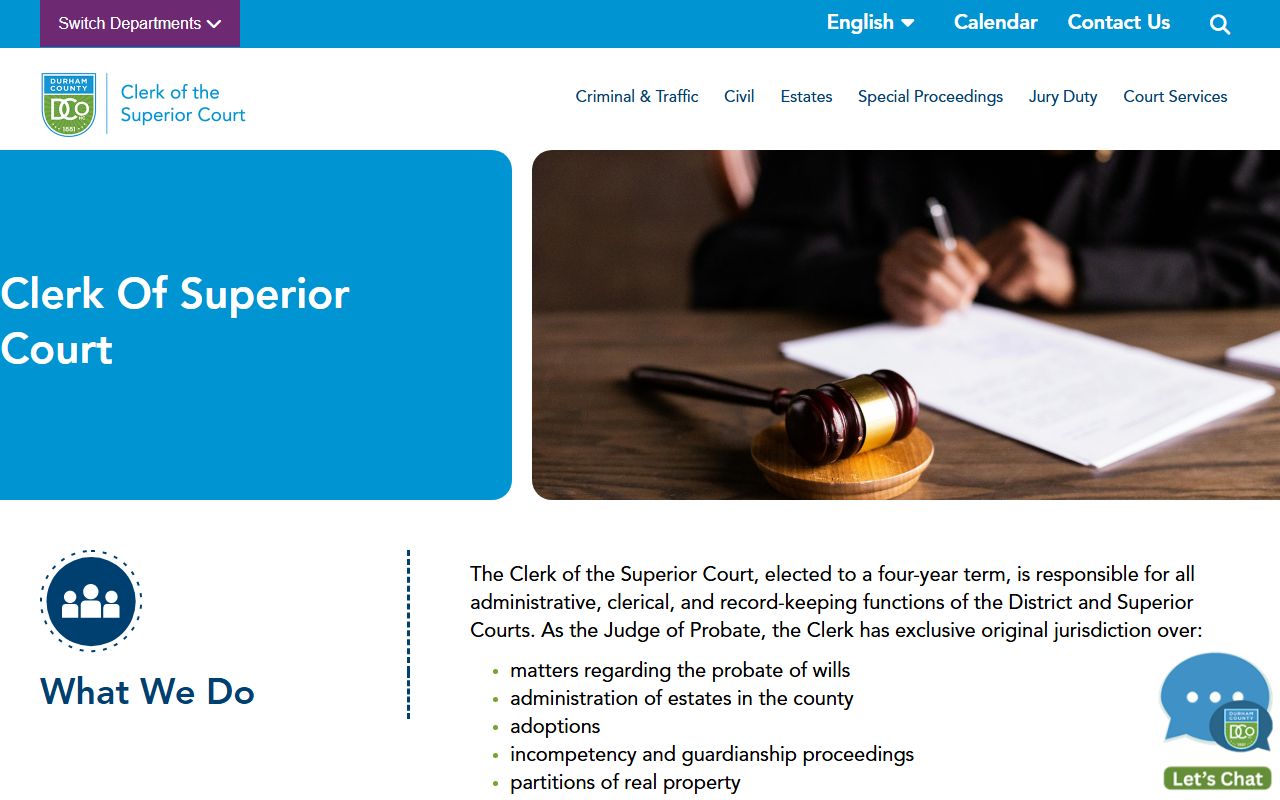
The page maps the rooms across several floors of the courthouse, so the right window is easy to find once you know your case type.
Durham County Clerk of Superior Court
Clerk: Aminah M. Thompson
510 South Dillard Street
Durham, NC 27701
(919) 808-3000
Durham.Clerk@nccourts.org
Mon-Fri, 8:30 a.m. to 5:00 p.m.
What the Durham County Clerk Does
The clerk is the record custodian for District and Superior Court cases in Durham County. That covers a long list of case types. The office handles administrative, clerical, and record-keeping duties for both trial divisions and keeps the files that the public later searches through the state portal. When you need a court file, a certified copy, or a payment receipt, the clerk's office is the source, not the state administrative office in Raleigh.
The main duties group into a few clear roles. Below is a short list of what the office does day to day.
- File and store pleadings, motions, orders, and judgments for both court divisions.
- Issue court process such as summons, subpoenas, writs, and notices.
- Collect court costs, fines, fees, bonds, and probation payments.
- Keep the official record and produce plain and certified copies on request.
- Act as judge of probate for wills, estates, guardianships, and many special proceedings.
For the case files themselves and how to read them, the Durham County court records page goes into more detail on what a search returns.
Durham County Clerk Divisions and Rooms
The clerk's office splits public work across several divisions, and each one sits in its own room in the Durham County Courthouse at 510 South Dillard Street. Knowing the room and the phone line saves time. Civil work, criminal and traffic work, superior criminal files, estates, special proceedings, judgments, and family court all have separate windows. The Cashier window takes court costs, certified background checks, and marriage payments tied to the courthouse.
The civil division is one of the busiest public windows. It takes pro se lawsuits, eviction filings, protective orders, certain liens, limited driving privilege requests, and recent divorce decrees. The official county civil page explains what the window can and cannot handle.
You can see the Durham County Clerk civil division page below.
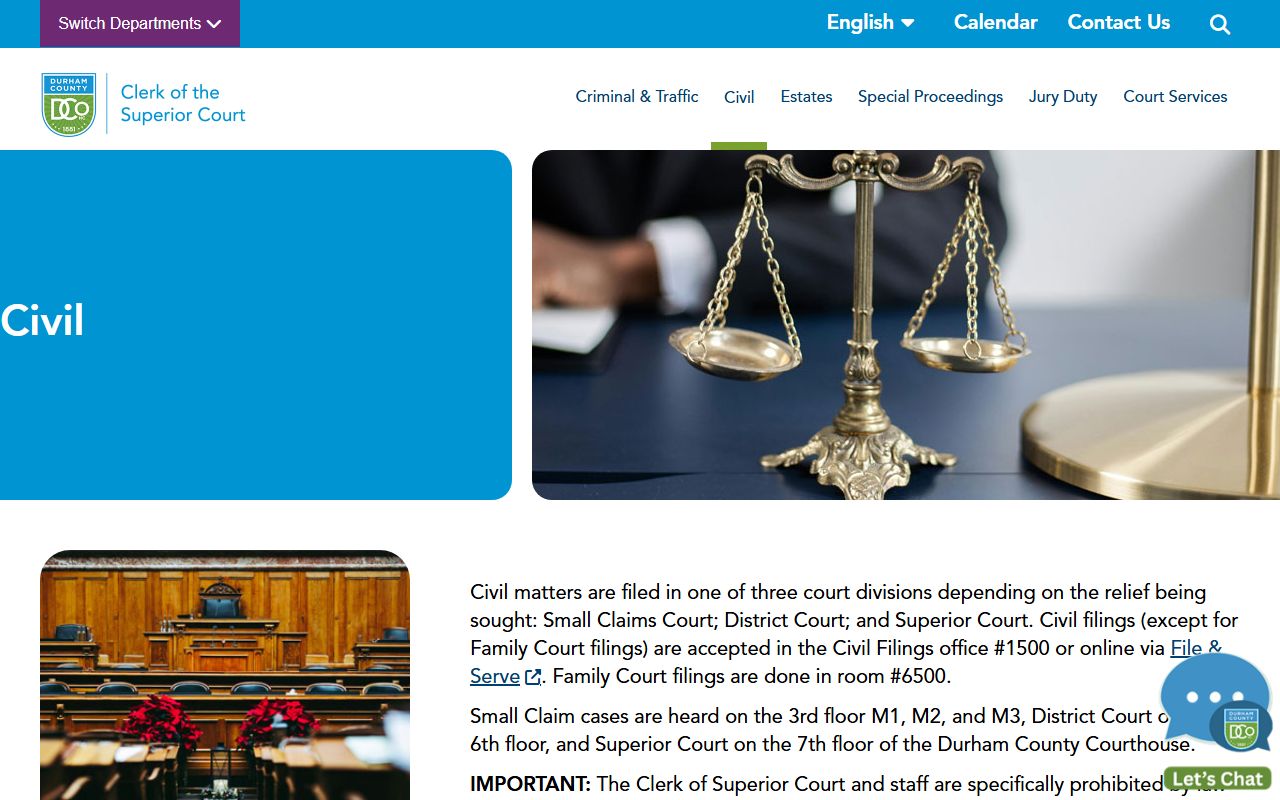
The civil window does not give legal advice, so plan to bring completed forms or use the self-help options before you arrive.
The table below lists the public divisions, their room and phone, and what each one handles. Pull the room number you need before you head downtown.
| Division | Phone / Room | Functions |
|---|---|---|
| Main Clerk | 919-808-3000 | Main office; mailing and physical address at 510 South Dillard Street. |
| Civil | 919-808-3003, Room 1500 | Pro se lawsuits, eviction filings, protective orders, liens, recent divorce decrees. |
| Criminal & Traffic Records | 919-808-3002, Room 1300 | Court dates, traffic citations, bond forfeitures, vehicle seizures. |
| Superior Criminal | 919-808-3007, Room 2100 | CRS bond forfeitures, superior criminal dates and courtrooms, CRS file copies. |
| Estates | 919-808-3004, Room 2300 | Wills and probate, inventories, year's allowance, guardianships, title transfer at death. |
| Special Proceedings | 919-808-3009, Room 2400 | Adult guardianship, name changes, adoptions, foreclosures, surplus funds, partitions. |
| Judgments | 919-808-3008, Room 1400 | Older divorce decrees, rent bonds, judgment collections, writs, miscellaneous liens. |
| Family Court | 919-808-3075, Room 6500 | Non-DSS custody, divorce filing, non-DSS child support. |
| Cashier | Room 1200 | Certified background checks, court costs, supervised probation, marriages. |
| Jury | 919-808-3130, Room 3000 | Jury duty matters. |
Note: Divisions sit on different floors of the courthouse, so confirm the current room and phone with the clerk before a visit in case a window has moved.
The Durham County Clerk as Judge of Probate
North Carolina does not have a separate probate court. Instead the Clerk of Superior Court acts as judge of probate. This is a real judicial role, not just a filing window. The Durham clerk has exclusive original jurisdiction over the probate of wills, estate administration, and guardianships. Most of this work runs through the Estates Division in Room 2300, phone (919) 808-3004.
The judge of probate role reaches further than estates alone. It also covers adoptions, incompetency and guardianship proceedings, partitions of real property, name changes, foreclosures under power of sale, petitions for surplus funds, and trust administration. Some of these matters go to Estates and some to Special Proceedings, based on the type of case. That is why the right room depends on what you are filing.
The county Estates page outlines the documents the division handles, from the original will through the final accountings.
You can view the Durham County Clerk Estates division page below.
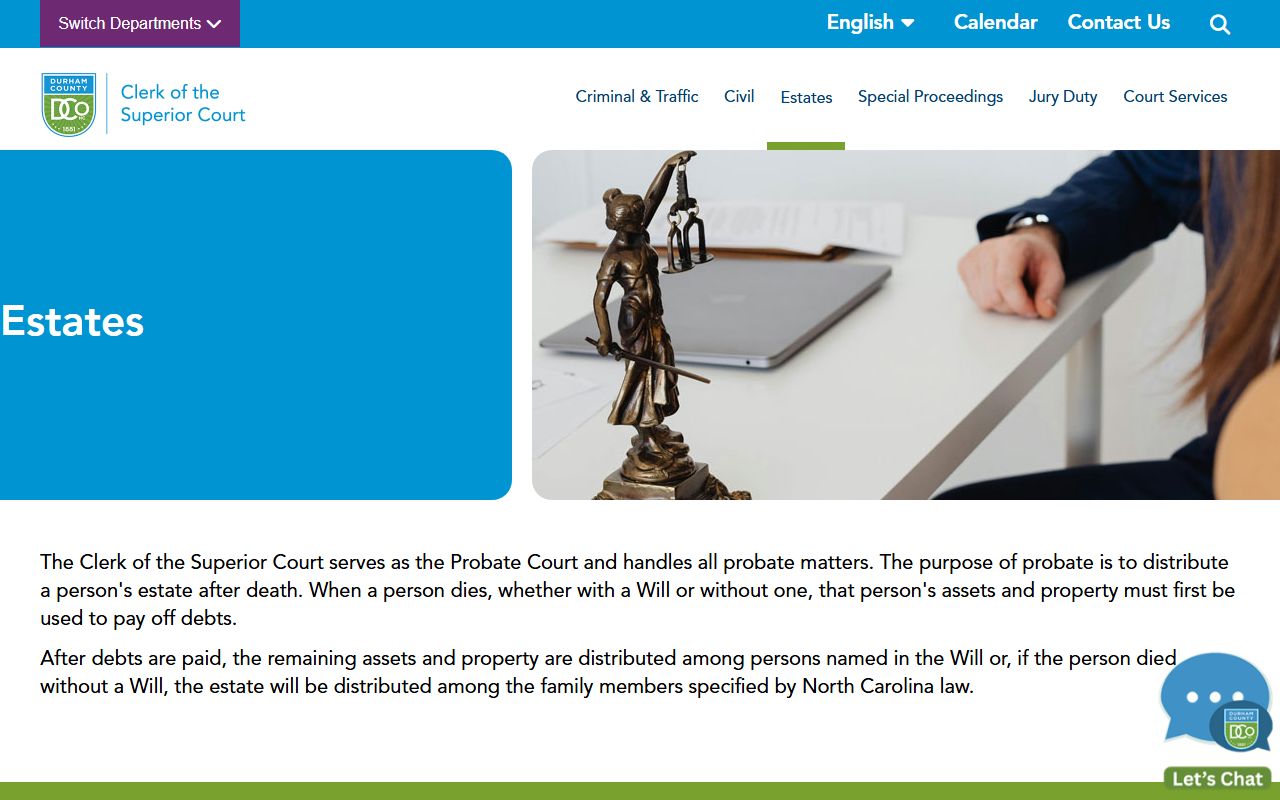
Because the clerk is a judge for these cases, official letters and certified estate filings come from the Estates window, not from any outside agency. The Durham County probate records page walks through estate searches and the step-by-step probate flow.
Criminal and Traffic Records at the Clerk
District-level criminal and traffic files run through the Criminal & Traffic Records window in Room 1300, phone (919) 808-3002. This division tracks court dates and courtrooms, traffic citations, bond forfeitures, vehicle seizures, and limited driving privilege requests tied to in-state speeding or a DWI. Felony files sit with the Superior Criminal window in Room 2100. Court costs are set by the state and listed on the clerk's traffic page, and they are separate from any fine the judge orders.
Many minor citations are waivable. That means a person can pay before the court date instead of appearing. Paying a waivable citation counts as pleading responsible or guilty to the original charge, which can affect a license or insurance. The clerk's traffic citations page explains payment options and the set court costs.
You can read the Durham County Clerk traffic citations page, shown below.
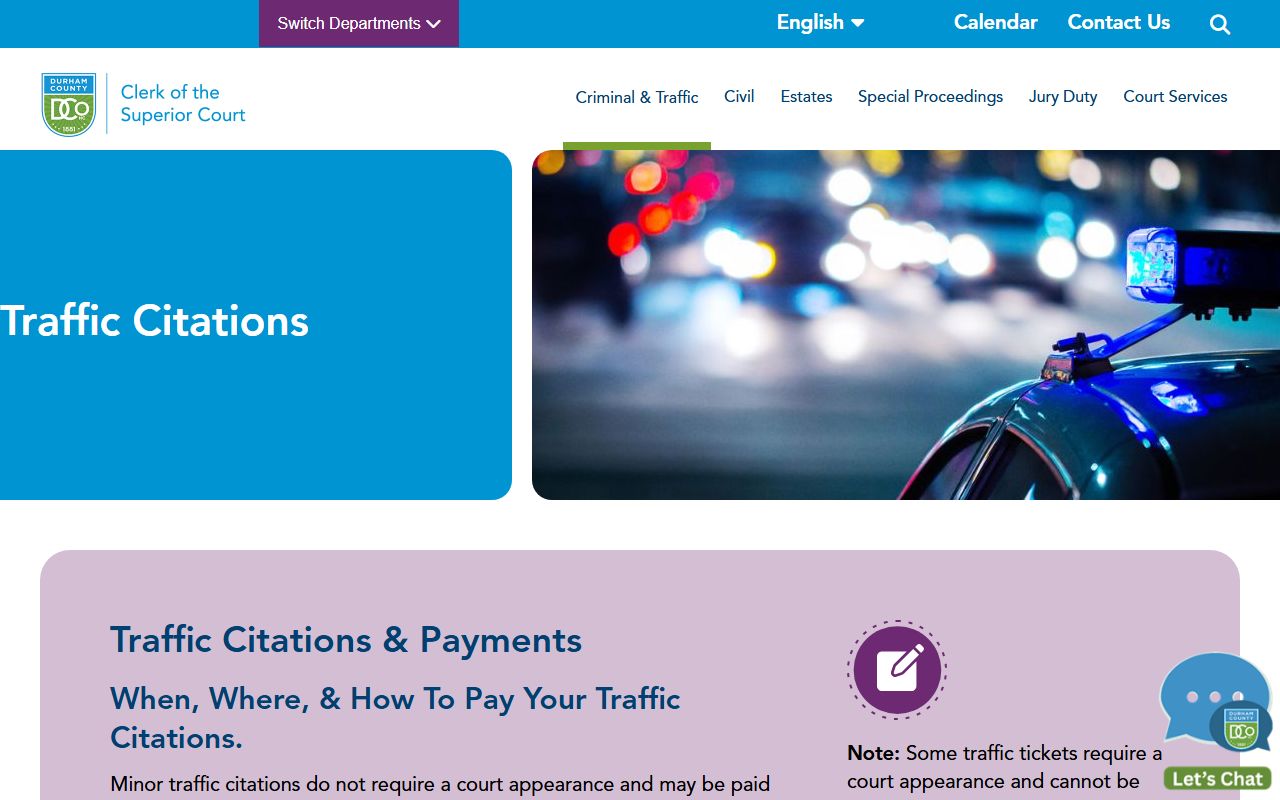
Before you pay, weigh the license and insurance effect of pleading to the charge. The Durham County traffic court records page covers contesting a ticket and how a court traffic record differs from a state driver record.
eCourts Tools for Durham County Records
The clerk's office links the public to the state's eCourts tools, which run on Tyler Technologies' Enterprise Justice platform. Four tools matter most for Durham County. Guide & File is a free service that helps prepare court documents for certain case types. File & Serve is the eFiling system for individuals and law firms with filing accounts. The Portal lets the public view court dates, hearings, case information, judgments, and documents, and pay fines and fees in criminal and infraction cases. Court Date Reminders send alerts so people do not miss a hearing.
These tools cut down on courthouse trips, but they do not replace the clerk. The Portal is public access, not the official record. For an official, stamped copy you still go to the clerk's division that holds the file. The state also publishes local rules and forms for Durham County that pair with the eCourts tools.
You can review the Durham County local rules and forms page below.
Start a case lookup on the North Carolina eCourts Portal, then turn to the clerk for any document you need certified.
How to Request a Certified Copy
A certified copy is an official copy with the clerk's stamp and signature. Courts, agencies, and other states accept certified copies as proof, while a plain printout from the Portal is not accepted as an official record. People often need certified copies for a divorce decree, a judgment, an estate file, or a criminal disposition. The right division depends on the case type, so identify your case before you request.
- Find the case number using the eCourts Portal Smart Search, or write down the party names and approximate filing date.
- Match your case to the correct division and room, such as Civil in Room 1500 or Estates in Room 2300.
- Visit or call that division and ask for a certified copy, giving the case number, party names, and document type.
- Pay the copy and certification charge at the Cashier window in Room 1200 or with the division, as directed.
- Pick up the certified copy, or arrange mail delivery if the division allows a mailed request.
Note: A divorce that ended within the last 12 months may live in the Civil division, while older divorce decrees sit with Judgments, so ask which window holds yours.
Durham County Clerk Fees
Court costs and copy fees come from a few sources. The clerk's traffic page lists set court costs for citation and other criminal cases, and those costs are separate from any fine. Certified-copy and vital-record fees for marriage, birth, and death certificates fall under the Register of Deeds schedule, not the clerk, because those records sit in a different office. The table gathers the figures the official Durham pages publish.
| Item | Amount |
|---|---|
| Traffic infraction court costs | $193 plus fine if any |
| Other criminal charge court costs | $191 plus fine if any |
| Register of Deeds certified copy | $5 first page, $2 each added page |
Marriage and vital-record fees are Register of Deeds charges, so a marriage license or a certified birth, death, or marriage certificate is requested there, not from the clerk. The Durham County Register of Deeds page lists those fees in full. For court copy and certification amounts, confirm the current charge with the clerk's division before you pay, since court-cost rules and local clerk practice can change.
The Clerk Among Durham County Court Officials
The clerk is one of several officials in the Durham County Courthouse, and it helps to know who does what. Superior and District Court judges decide cases. The District Attorney prosecutes criminal matters. Magistrates, who are officers of District Court, handle small claims, landlord-tenant disputes, initial criminal process, warrants, and marriage ceremonies. The clerk keeps the records for all of it and rules on probate and special proceedings as judge of probate.
The state publishes a plain-language guide to these roles, which is useful when a record names an official you do not recognize.
You can review the North Carolina court officials page, shown below.
For the trial court itself and how cases move through it, the Durham County Superior Court page covers the judges, jurisdiction, and case flow that the clerk's records track.