
What Probate Covers in Durham County
Probate is the court process for settling what a person owns and owes after death. In Durham County, that work runs through the Estates Division of the Clerk of Superior Court. The Clerk acts as judge of probate and has exclusive original jurisdiction over the probate of wills, estate administration, guardianships, and related matters. The Estates Division handles wills and probate, estate inventories, year's allowance claims, guardianships, and the transfer of title because of death. So a single county office, not a stand-alone probate court, oversees most of what people call probate in North Carolina.
The Clerk's broader role as judge of probate reaches further than estates alone. It also covers adoptions, incompetency and guardianship proceedings, partitions of real property, name changes, foreclosures under power of sale, petitions for surplus funds, and trust administration. Those matters split between two rooms. Estates takes wills, inventories, and decedent estates. Special Proceedings takes adult guardianships, name changes, adoptions, foreclosures, surplus funds, and partition cases. Both sit on the second floor of the Durham County Courthouse downtown.
This setup is different from states that run a separate probate court with its own judge. Here the Clerk of Superior Court is the judicial officer for probate and for many special proceedings. The right local terms are the Estates Division for decedent estates and Special Proceedings for guardianships and the other matters listed above.
Probate Terms Defined
Estate files use words that show up again and again. A quick glossary helps before you read a will, an order, or a Durham County probate record. These terms apply the same way across North Carolina, since state estate law governs the process.
- Testator
- A person who dies leaving a valid will. The will names how the estate should be handled.
- Executor
- The person named in a will to carry it out and settle the estate.
- Administrator
- The personal representative the Clerk appoints when there is no will or no named executor able to serve.
- Intestate
- Dying without a will, so North Carolina law decides who inherits.
- Year's Allowance
- A set amount a surviving spouse or child may claim from the estate ahead of most other claims.
- Guardianship
- A court arrangement that gives one person legal authority to make decisions for a minor or an adult who cannot manage their own affairs.
Note: The Clerk's staff can explain estate procedure and which form to file, but they cannot give legal advice about your specific case.
How to Search Durham County Probate Records
Probate and estate cases can be searched through the North Carolina eCourts Portal. Use Smart Search and the Estates filter, then enter the full name of the person who died. The Portal runs on Tyler Technologies' Enterprise Justice platform, the same system every North Carolina county now uses. It is public access, not the official record, so plan a second step at the Clerk's Estates Division if you need a certified copy or an older file.
One warning matters most for estates. Enterprise Justice is party-based, so a common name can return any case where that name appears in a party role. That is why full names and filters beat a quick name guess. The steps below follow the Estates path.
- Open the eCourts Portal and choose Smart Search. Enter the full name of the person who died.
- Open Advanced Filtering and select the Estates category, then narrow to Durham County.
- Add a filing date range or case status to cut down a long list of common-name results.
- Open the case summary to review parties, case events, and any orders the Clerk has entered.
- Request certified copies or Letters from the Durham County Clerk's Estates Division if you need an official document.
The Estates search uses a small set of fields. The table lists the ones that matter for a Durham County probate records search.
| Search Field | Type | Notes |
|---|---|---|
| Smart Search name field | Text | Use the full name of the person who died for estate cases. |
| Estates filter | Advanced filter | Recommended for probate and estate cases. |
| Case status | Dropdown / filter | Active, open, or closed if the option is shown. |
| Filing date range | Date range | Helps narrow older estates and common names. |
| Location | Dropdown / filter | Select Durham County for local results. |
Older estates may need clerk help even when the Portal shows nothing. Estate files can be indexed by the name of the person who died, the personal representative, or the case number. If a search comes back blank, that does not prove no estate exists.
The Clerk as Judge of Probate
North Carolina puts probate in the hands of the Clerk of Superior Court, not a separate probate judge. The Clerk keeps court records under state law and is allowed to offer remote electronic access where the law permits. That record-keeping duty is the legal backbone for how estate files are stored, indexed, and shared with the public through the eCourts Portal.
You can read the statute that sets these clerk duties, N.C.G.S. 7A-109, on the North Carolina General Assembly site.
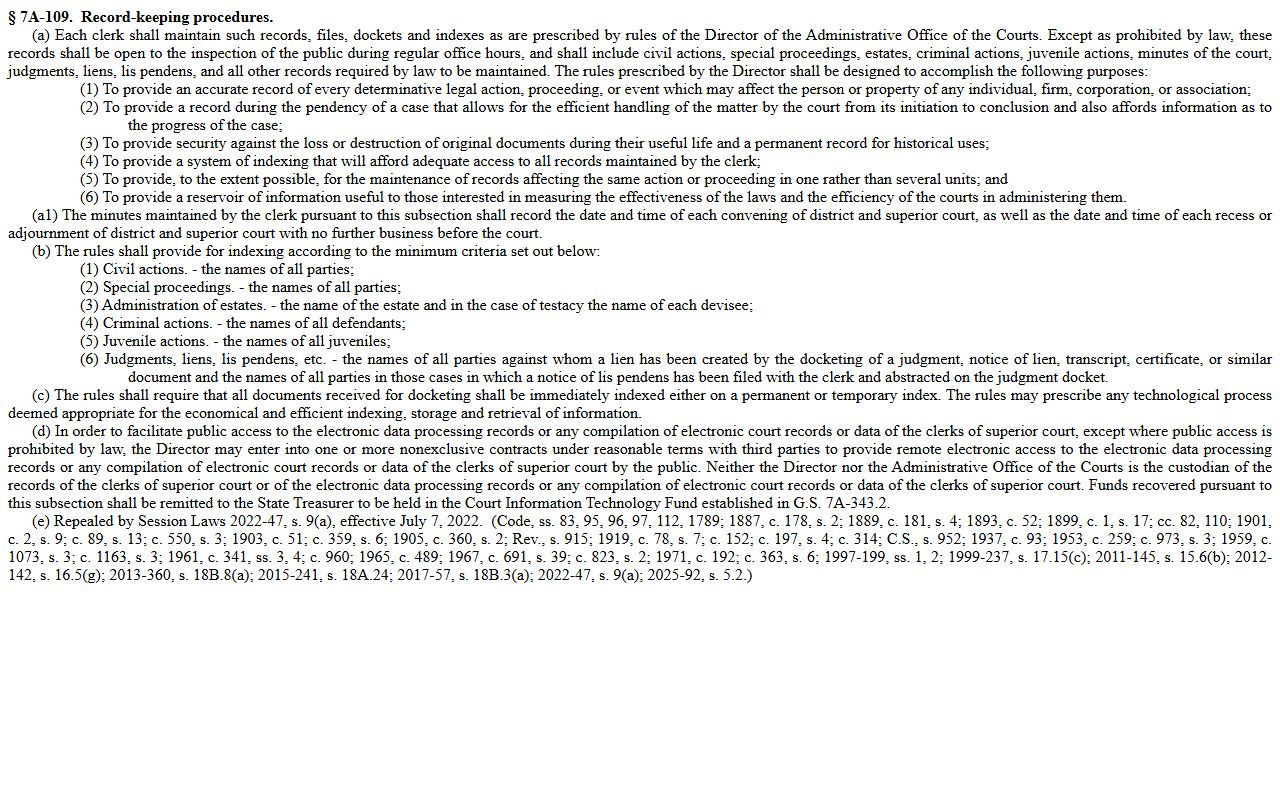
That same record-keeping authority is why the Clerk, and not the state administrative office, is the custodian for Durham County estate files and the source for certified copies.
Because the Clerk handles probate as a judicial officer, the Estates Division can issue Letters testamentary or Letters of administration that prove who has authority to act for an estate. Banks, title companies, and other agencies often ask for those Letters before they release assets. The Portal will show the case, but the official Letters and certified filings come from the Clerk.
Durham County Estates and Special Proceedings Offices
Two divisions of the Clerk handle most probate-adjacent work, and both sit in the Durham County Courthouse on the second floor. Estates takes decedent estates, wills, and inventories. Special Proceedings takes adult guardianships, name changes, adoptions, foreclosures, surplus funds, and partitions. Knowing which room to call saves a wasted trip downtown.
Clerk of Superior Court, Estates Division
510 South Dillard Street
2nd Floor, Room 2300
Durham, NC 27701
(919) 808-3004
Mon-Fri, 8:30 a.m. to 5:00 p.m.
Clerk of Superior Court, Special Proceedings
510 South Dillard Street
2nd Floor, Room 2400
Durham, NC 27701
(919) 808-3009
Mon-Fri, 8:30 a.m. to 5:00 p.m.
Estates handles wills and probate, inventories, year's allowance claims, guardianships, and the transfer of title after death. Special Proceedings handles adult guardianship, name changes, legitimization and proof of birth, adoptions, foreclosures under power of sale, surplus funds, partitions, cartway cases, and boundary disputes. A few matters, such as guardianships, can touch both divisions depending on the type. When in doubt, call the Estates Division first and let staff point you to the right room.
How Probate Works in Durham County
Opening an estate follows a set order. The path below tracks the usual Durham County steps, from the first question about a will to the certified copies at the end. Small estates may use a simpler procedure, so ask the Estates Division before you assume a full administration is needed.
- Find out whether the person who died left a will, owned assets that need estate administration, and whether a small estate procedure may fit.
- Contact the Estates Division at (919) 808-3004 or visit Room 2300 to get the right forms and instructions.
- File the original will, if one exists, along with the required estate application forms.
- The Clerk reviews and qualifies the personal representative, whether that is an executor named in the will or an administrator.
- Required notices, inventories, accountings, creditor handling, and distributions move forward under North Carolina estate law.
- Search the Portal with the full name of the person who died and the Estates filter to follow public case information.
- Request certified copies or Letters from the Clerk, since the Portal is public access and not the official record.
The time an estate takes depends on its size, creditor claims, and whether any dispute comes up. A simple estate can close faster than one with property, debts, or a will contest.
What Durham County Probate Records Show
An estate file builds up a stack of documents as the case moves along. The exact contents vary by estate, but most Durham County probate records draw from a common set of filings. These are the document types you are likely to find when you open or request an estate file.
- Original will filed for probate and the application or petition to administer the estate.
- Oath of the personal representative and the Letters testamentary or Letters of administration.
- Inventory of estate assets and the later accountings.
- Year's allowance filings for a surviving spouse or child.
- Orders approving estate actions, plus notices to creditors.
- Receipts, releases, and the closing documents that end the case.
Guardianship petitions and orders may sit in Estates or Special Proceedings depending on type. Individual documents and any related fees should be verified with the Estates Division, since not every paper in a file is open to the general public and some carry restricted personal data.
Durham County Probate Filing Fees
Probate fees in Durham County follow the statewide court cost schedule set by the North Carolina Judicial Branch, not a separate local probate fee list. Estate filing fees, qualification costs, and certified-copy charges are tied to those state court-cost rules and clerk practice. A specific Durham probate fee table was not confirmed in the research for this page, so the honest answer is to verify current amounts with the source below.
Note: Confirm current estate filing fees, qualification costs, and certified-copy charges with the Durham County Clerk's Estates Division before you file, since court-cost amounts can change.
Certified copies and Letters carry their own copy and certification charges under the court-cost rules. When you call the Estates Division at (919) 808-3004, ask for the fee that matches the exact document you need, whether that is Letters of administration, a certified will, or a copy of an accounting.
Confidential Durham County Probate Records
Not every probate-adjacent record is open to the public. North Carolina seals or restricts several record types that the Clerk handles. Adoption records are confidential and sealed under N.C.G.S. 48-9-102, except for the decree and the special proceedings index entry. Incompetency and guardianship files can hold medical and personal data subject to restricted access. To view a sealed record, you usually need a statute that allows it or a court order.
The statute that seals adoption records, N.C.G.S. 48-9-102, is published on the North Carolina General Assembly site.
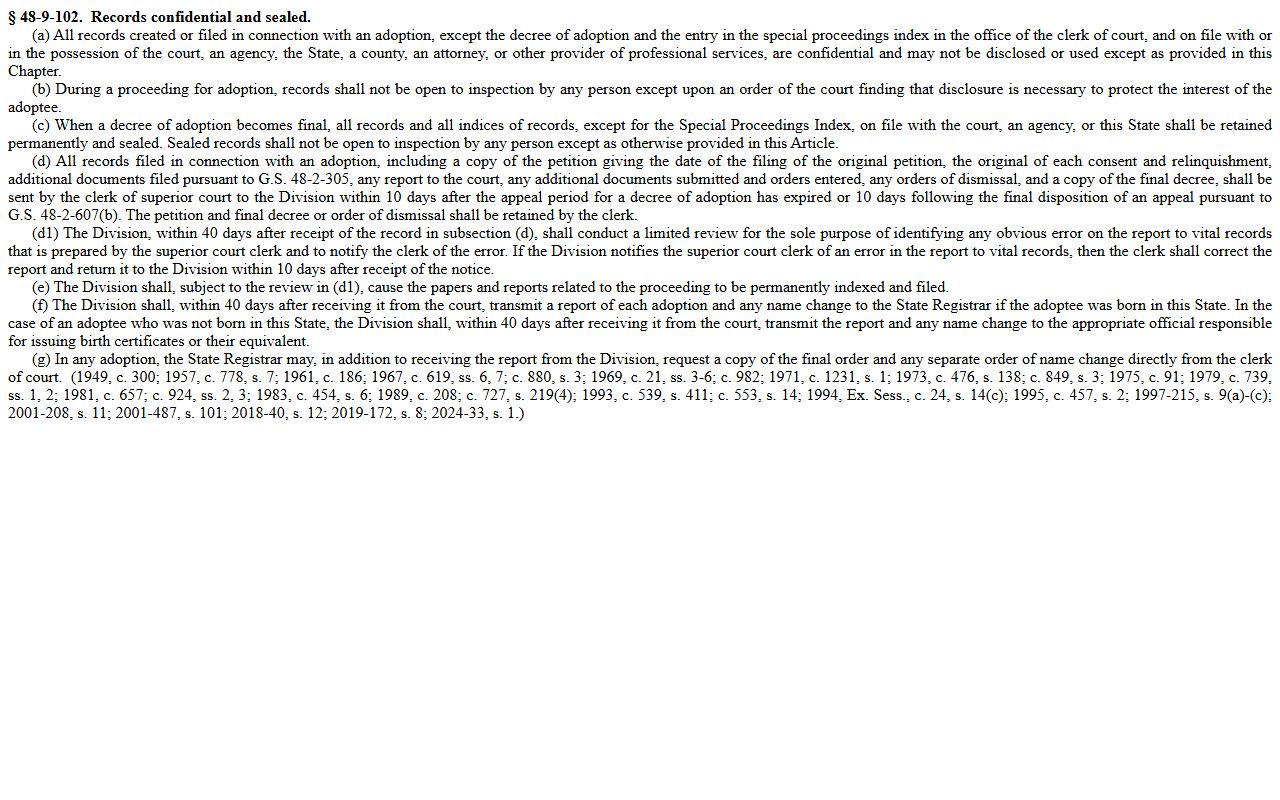
That seal is why an adoption handled through Special Proceedings shows little more than an index entry to the general public.
Mental health commitment proceedings are confidential too. Court records made in involuntary commitment cases are not open to the general public except as the law allows. These cases run under Chapter 122C, and the same confidentiality can touch guardianship matters that involve a person's mental capacity.
The commitment confidentiality rules sit in Chapter 122C, Article 5, shown on the North Carolina General Assembly site.
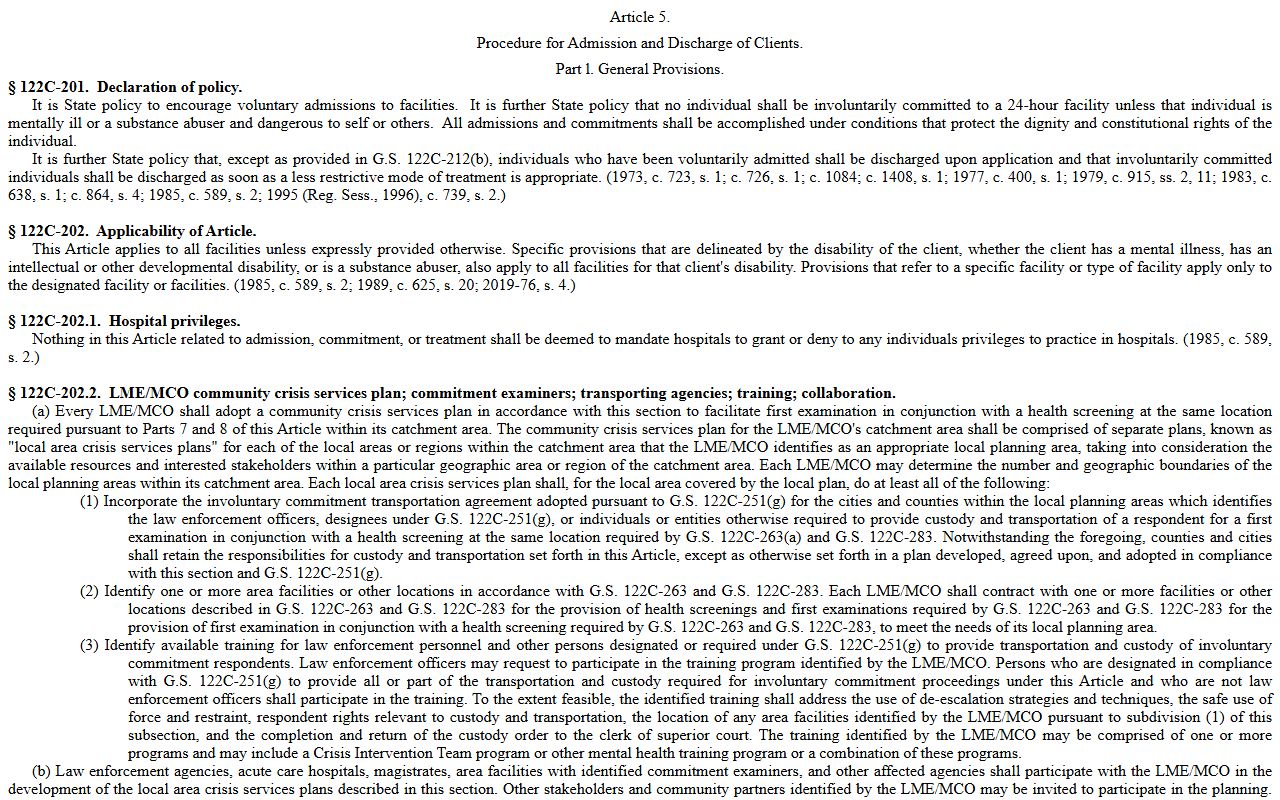
Because of these rules, a guardianship file tied to mental capacity may show only limited public information.
Other Restricted Court Records
Probate sits next to other confidential record types in the same court system, and people researching an estate sometimes run into them. Juvenile records are confidential under N.C.G.S. 7B-3000, and access is limited to people the law names, such as the juvenile, a parent, an attorney, or a prosecutor. Family files connected to a guardianship of a minor can carry the same protection.
The juvenile confidentiality statute, N.C.G.S. 7B-3000, is posted on the North Carolina General Assembly site.
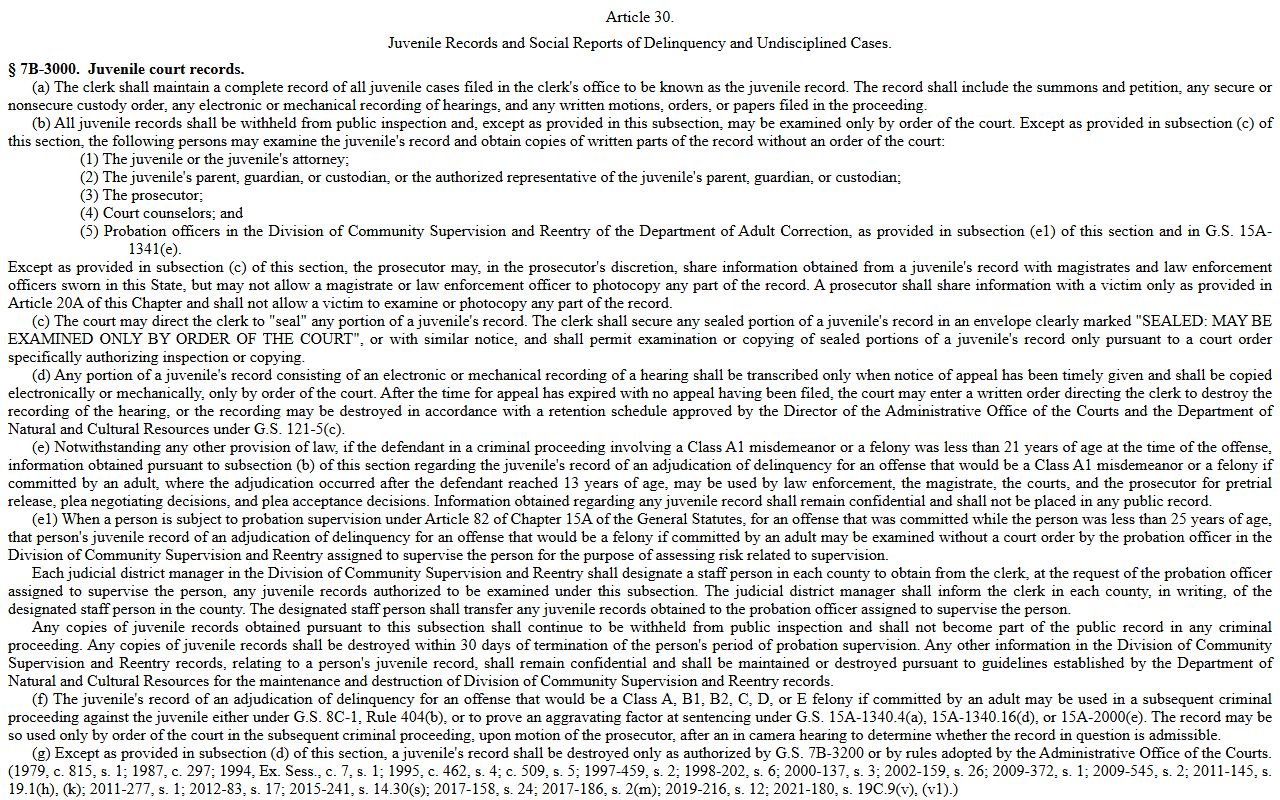
That confidentiality is why a minor's guardianship can look very different in the public record than an adult estate case.
Expunged criminal records are removed from public view as well, which matters when an estate involves someone whose old charges were cleared. North Carolina allows expunction of certain nonviolent convictions under N.C.G.S. 15A-145.5, with waiting periods and exclusions. An expunged case no longer shows up in the public portal.
You can read the nonviolent-conviction expunction statute, N.C.G.S. 15A-145.5, on the North Carolina General Assembly site.
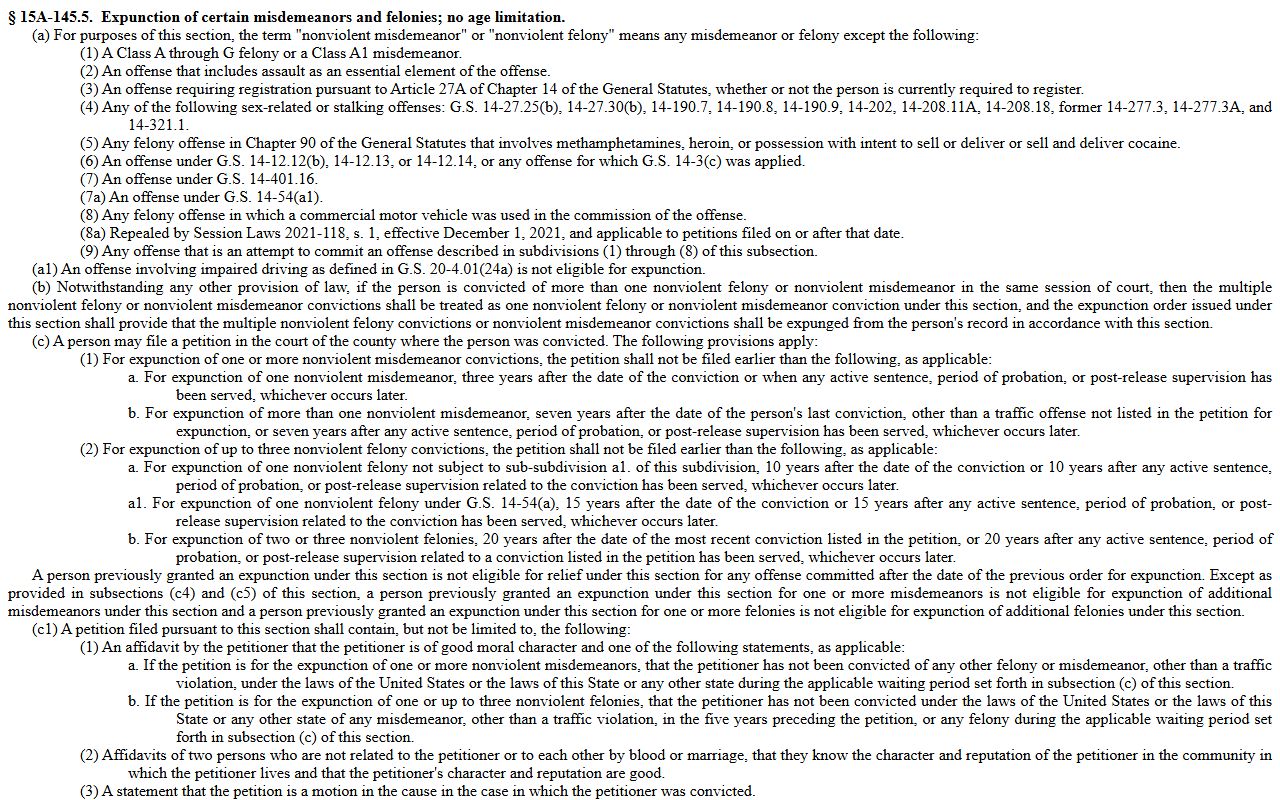
Expunction sits in the broader criminal procedure chapter that also governs how Durham charges are filed and cleared.
The full Chapter 15A statute index, which collects expunction and other criminal procedure sections, is on the North Carolina General Assembly site.
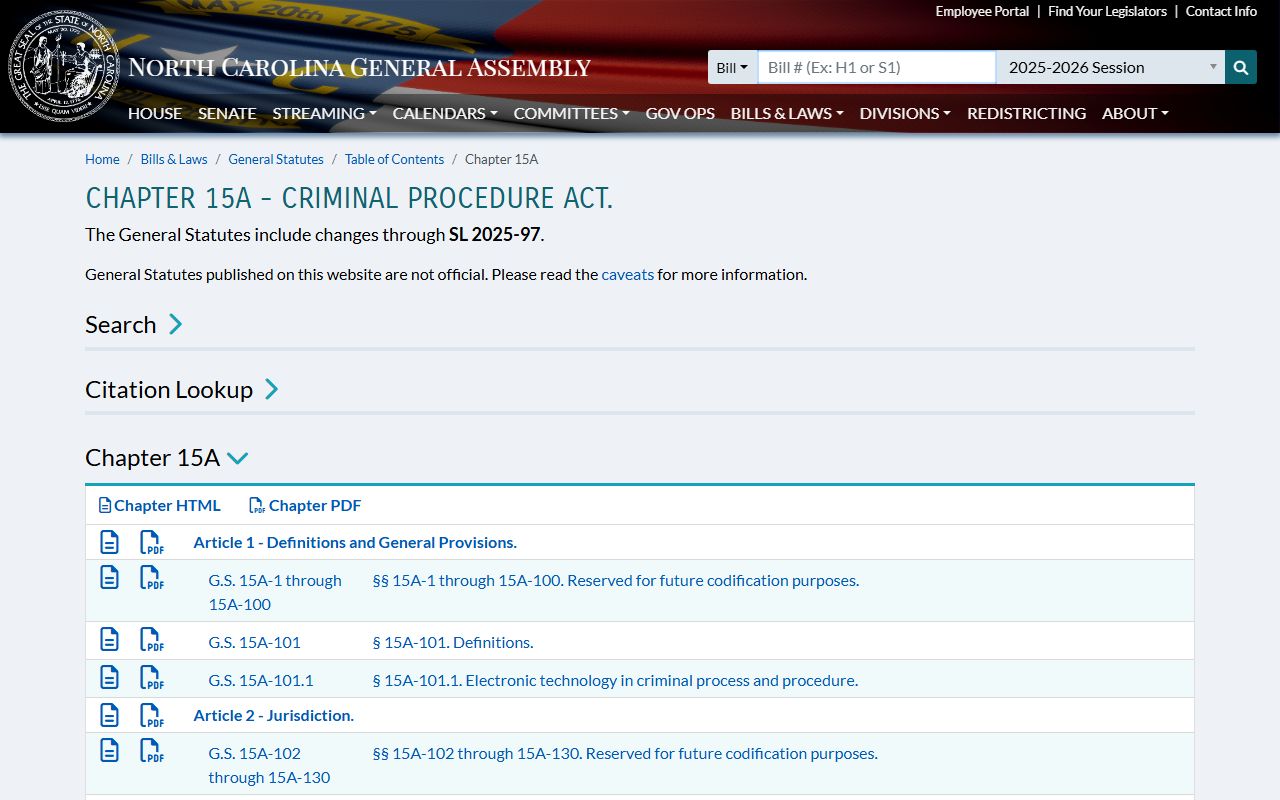
Reading the index helps you find the exact expunction section that fits a dismissed or cleared case.