
Active Warrants in Durham County
Active warrants in Durham County come from the courts. A magistrate or a judge signs them. The Durham County Sheriff's Office then serves them and makes the arrest. Most active warrants tie to a criminal charge, but some come from a missed court date or a probation problem. The key fact for anyone searching is simple. Durham County does not run a public website where you can pull up active warrants by name.
The Sheriff's own guidance is blunt on this point. Warrant Control staff will not give out active warrant information over the phone. Instead, they direct people to the Warrant Control Center inside the Durham County Jail at 219 South Mangum Street. So there is no name box to type into for live warrants. You either go in person, work through a lawyer, or look at what the court system makes public.
Active warrants stay limited for a reason. Telling a wanted person that officers are coming can let them flee or hide. Once a warrant is served or returned, the rules change and it becomes a public court record. That shift, from active to returned, is the heart of any Durham County warrant search.
Types of Warrants in Durham County
Not every warrant means the same thing. Durham County courts handle several kinds, and each starts a different process. Some let police arrest a person. Some let them search a home or car. Others pull someone back to court who skipped a date. Knowing the type helps you read a record and judge how serious it is.
- Arrest warrant - a court order that lets officers arrest a named person for a charged crime.
- Bench warrant / order for arrest - issued by a judge when someone fails to appear, breaks a court order, or is in contempt.
- Search warrant - allows officers to search a place or thing for evidence named in the order.
- Fugitive warrant - used to hold a person wanted in another state until that state acts.
- Criminal summons - orders a person to appear in court without an immediate arrest.
Civil process is its own track. Orders tied to contempt or child support enforcement can also lead to arrest. A bench warrant, often called an order for arrest in North Carolina, is the one most people meet. It can flow from a failure to appear, a probation violation, a failure to follow a court order, or contempt of court.
How to Search Durham County Warrants
There is no single warrant portal to query, so a Durham County warrant search means checking the court case instead. The North Carolina eCourts Portal is the best free tool. It shows case summaries, parties, hearings, and case events. When a court issues, serves, returns, resets, or recalls a warrant, that action can post to the case as an event. So a person's open case may reveal a warrant even when no warrant list exists.
The steps below show how to look without paying a third-party site. Start with the court system. Then, if you must act on an active warrant, follow official Sheriff guidance.
- Open the North Carolina eCourts Portal and choose Smart Search.
- Enter a party name or a case number, then narrow the results to Durham County.
- Open the case and read the case events list for any warrant, order for arrest, or criminal summons entry.
- Note whether the event reads issued, served, returned, reset to unserved, or recalled.
- For an active warrant, contact a lawyer or the Warrant Control Center at the jail rather than calling for warrant details by phone.
Keep your expectations honest. The Portal posts court events, not the Sheriff's full active-warrant file. A clean case page does not prove a person is clear. Mental health confidentiality rules also limit what shows in some matters. You can read one such rule, the mental health disclosure statute at N.C.G.S. 122C-54, on the state legislature site.
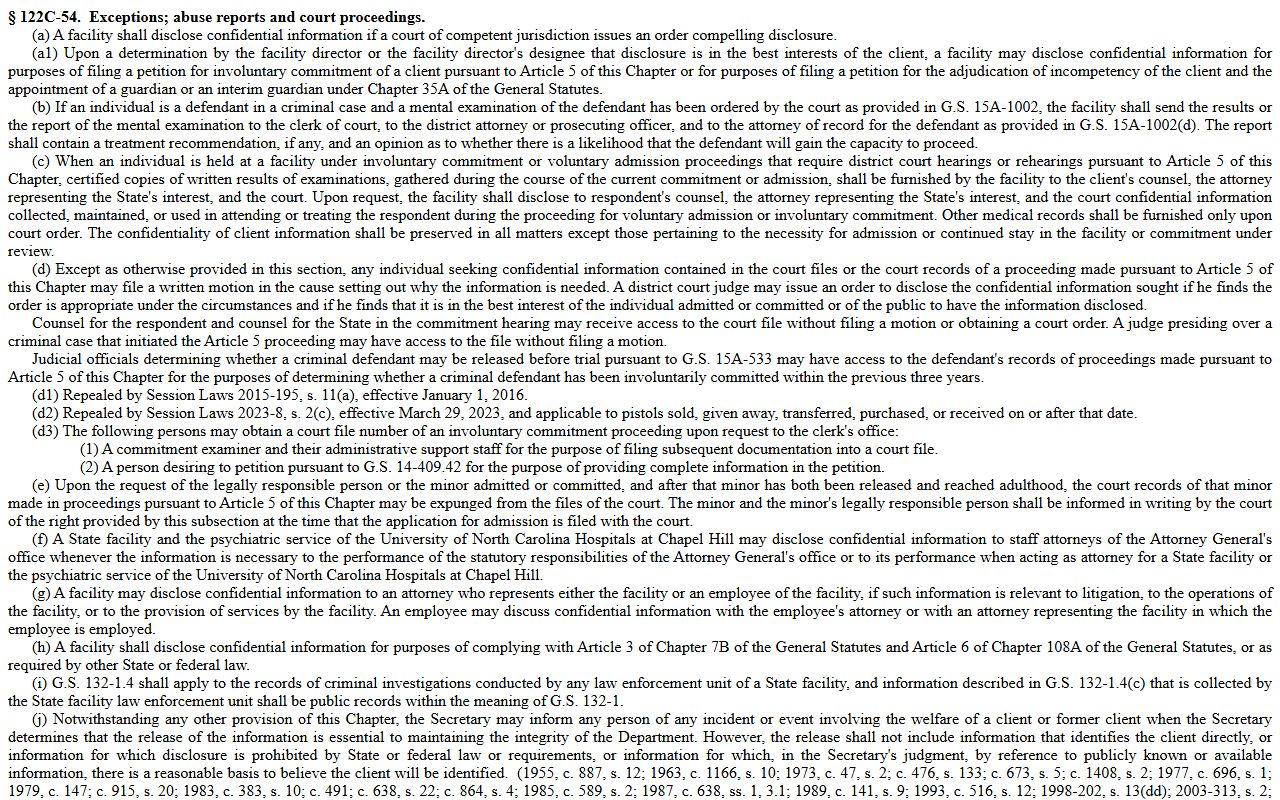
That statute shows why some warrant and order events in commitment matters never reach the public side of a Durham County warrant search.
Durham County Warrant Search Fields
People expect a warrant page with a name field and a date of birth box. Durham County has no such page for active warrants. What you can search is the court system, where warrant-related events sit inside the case. The table sets out what is real and what is not, so you do not waste time hunting a portal that does not exist.
| Search Path | Type | Notes |
|---|---|---|
| Public active warrant portal | None | No public Durham active-warrant list was located; the Sheriff directs people to the Warrant Control Center at the jail. |
| Phone request to Warrant Control | Not available | Sheriff guidance says staff will not give active warrant information over the phone. |
| eCourts Smart Search | Name or case number | Use it to find a case, then read the case events for warrant entries. |
| Case events section | Record view | Events may show warrants, orders, or summonses issued, served, returned, reset to unserved, or recalled. |
| County filter | Filter | Limit Smart Search results to Durham County to cut noise. |
So the search field that matters is the case event, not a warrant box. That is a real difference from the model many people picture. Work the case, and the warrant detail tends to follow.
What a Durham County Warrant Record Shows
When a warrant is returned, it becomes a public court record and carries a set of standard fields. State law makes returned arrest and search warrants, indictments, and criminal summonses public unless a court seals them. The list below shows what a returned Durham County warrant record, or its case event, tends to include. Exact labels vary by case type, but the data points hold steady.
| Field | What It Shows |
|---|---|
| Case Number | The court file the warrant or order belongs to. |
| Defendant Name | The person named in the warrant or order for arrest. |
| Charge / Offense | The crime or matter that drove the warrant. |
| Issuing Official / Court | The magistrate or judge and the division that signed it. |
| Warrant / Order Type | Arrest warrant, order for arrest, search warrant, or criminal summons. |
| Issued Date | The date the court signed the warrant or order. |
| Served / Returned / Recalled Date | When officers served it, returned it, or the court recalled it. |
| Bond | Any release condition or bond amount set on the matter. |
| Related Court Date | The next hearing tied to the case. |
Some of these fields can be masked. Sealed warrants do not appear at all. For the underlying charge and case history, the Durham County arrest records page and the court records page go deeper than a warrant view can.
Returned Warrants as Public Records
The line between hidden and open turns on one word: returned. An active warrant is held close while officers work to serve it. Once served or returned to the court, it joins the public case file. State law, N.C.G.S. 132-1.4, draws this line. It keeps criminal investigation files private but makes returned arrest and search warrants, indictments, and criminal summonses public unless a court order seals them.
That is why a Durham County warrant search through the court system can work after the fact. The case event shows the warrant moved from issued to served or returned. From there, the file behaves like any other public court record. The custodian for a county case file is the Durham County Clerk of Superior Court, not the state office, so certified copies come from the Clerk. The Clerk of Superior Court page covers how to request them.
Note: A returned warrant is public, but a sealed warrant or a sealed indictment stays out of public view until the court unseals or returns it under the rules.
Warrant Control, Bond, and Magistrates
The Warrant Control Center sits inside the Durham County Jail at 219 South Mangum Street. It is the official point for active warrant matters, since the Sheriff will not field those by phone. Criminal magistrates work on the lower levels of the same building. They handle preliminary steps such as warrants, orders, initial appearance, and release conditions. So a person taken into custody on a warrant meets the magistrate process right there.
Bond uses set North Carolina terms. Release may be a written promise to appear, an unsecured bond, a secured bond, custody release, or no bond at all. The choice depends on the charge and the judicial decision. A secured bond means money or a surety must be posted before release. A note of "no bond" in a news item is not the end of a case. It only sets the release condition at that point. Court dates and full status should be checked in the Portal, because the jail roster reflects custody, not the whole case.
For who is currently held, the Durham County inmate records page covers the jail roster. After release, the released inmates page covers state and federal locators.
How to Resolve an Outstanding Warrant
An open warrant does not fix itself, and ignoring it tends to make things worse. A traffic stop or a routine check can turn into an arrest at the wrong time. The steps below track official guidance. They favor the court system and a lawyer over guesswork, and they steer clear of sites that promise warrant data they cannot deliver.
- Do not rely on unofficial warrant sites; their data can be wrong or stale.
- Check the eCourts Portal for public case events and any scheduled court date.
- Contact an attorney, or the Public Defender process if you are indigent and eligible.
- Go to the Warrant Control Center at the Durham County Jail if official Sheriff guidance directs you there.
- If you turn yourself in, bring identification, medication information, and any bond or payment resources.
- Expect a magistrate or a judge to review your release conditions.
- After the matter clears, confirm the status in the Portal or with the Clerk or Sheriff, allowing time for updates.
Important: Talk to a lawyer before you turn yourself in, since timing, bond, and the right court setting can shape how the day goes.
Federal Warrants and Court Records
Some warrants in Durham County are federal, not state. Durham sits in the U.S. District Court for the Middle District of North Carolina. Federal criminal cases, civil rights matters, and other federal categories run through that court, and federal warrants come from federal judges and magistrate judges. Those records do not show up in the state eCourts Portal. They live in the federal docket system instead.
Federal court records run on PACER and the CM/ECF filing system. You need a PACER account, and fees can apply for docket and page access unless waived. The federal court lookup page lists how to reach the Middle District's electronic system.
The PACER court lookup for the North Carolina Middle District is shown below.
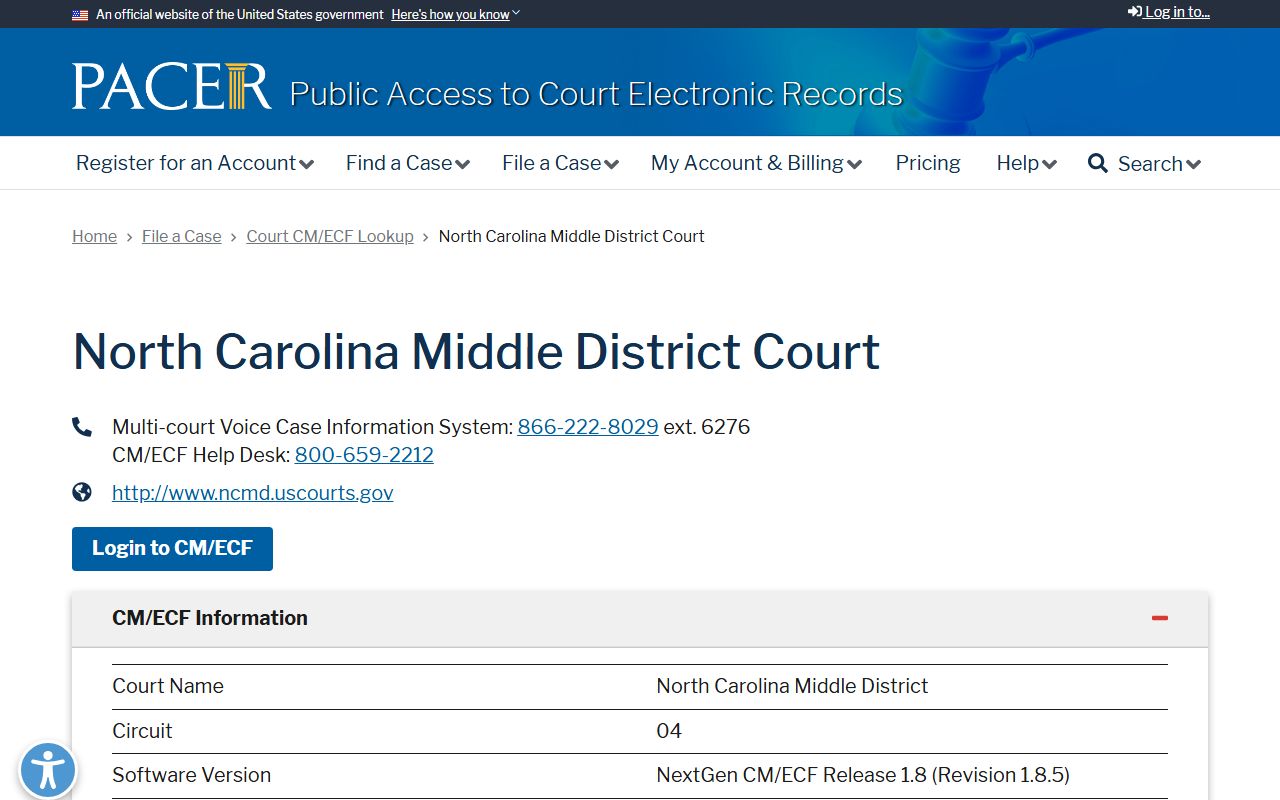
You can confirm the system and access points on the PACER CM/ECF court lookup for the district.
Bankruptcy is a separate federal court with its own filing system. The U.S. Bankruptcy Court for the Middle District of North Carolina explains how registered filers and PACER users reach its documents.
Its CM/ECF information page appears below.
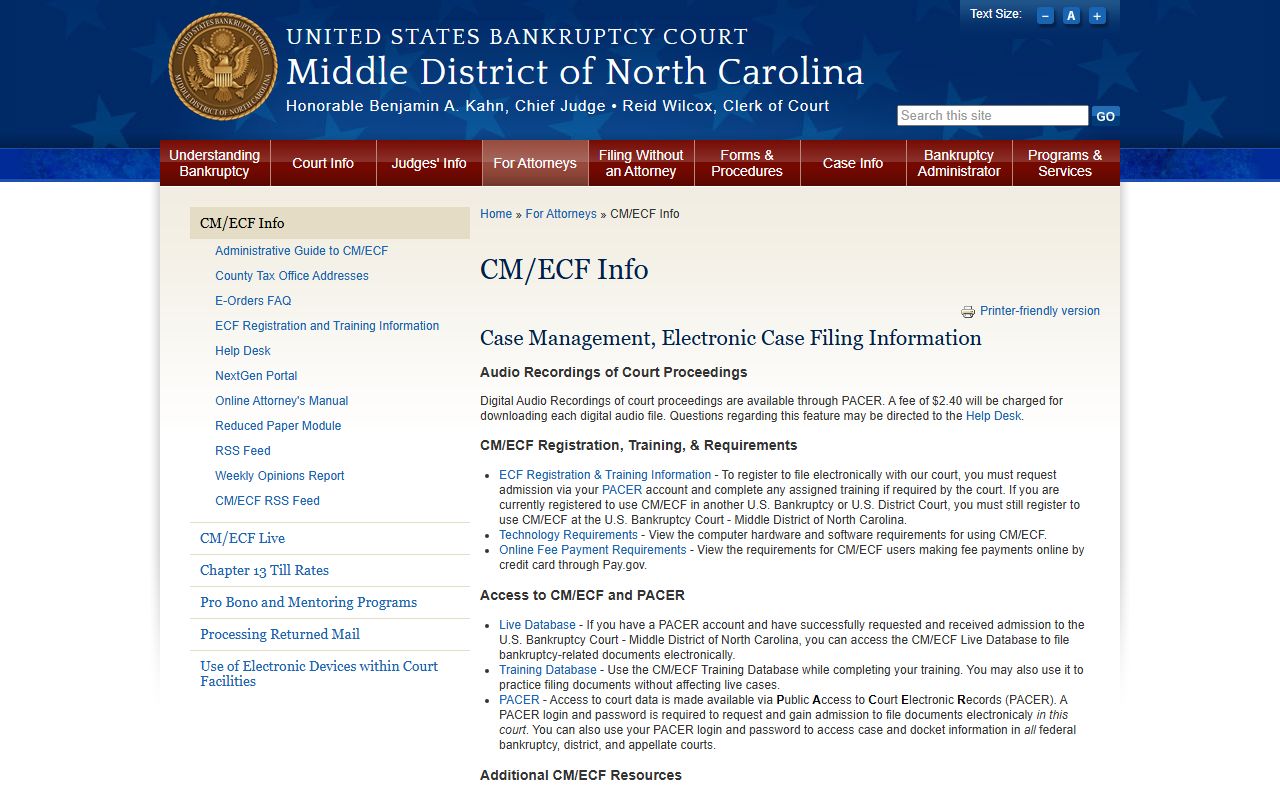
You can read the filing and access notes on the Bankruptcy Court CM/ECF page before you set up access.
Federal cases for Durham are heard at the John Hervey Wheeler Courthouse downtown. The court's location page lists the address, the magistrate judge, and clerk contact details.
The Durham federal courthouse page is shown below.
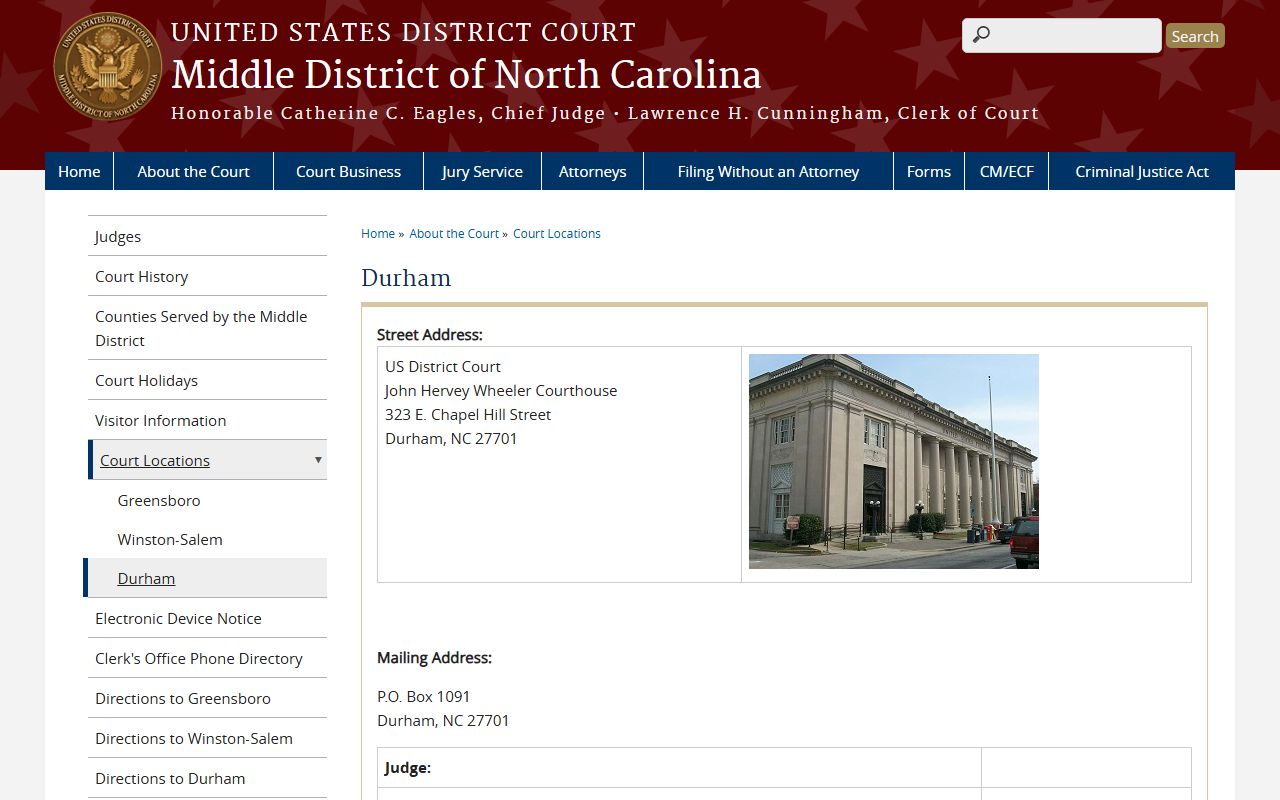
You can find the building details on the U.S. District Court Durham location page, which sits a few blocks from the county courthouse.
Restricted Durham County Warrant Records
Not every warrant becomes public. Sealed warrants and sealed indictments stay private until a court unseals them or they are returned under rules that open them. A judge seals records to protect an investigation, a witness, or a person's safety. So a missing entry in a Durham County warrant search does not always mean no warrant exists.
Juvenile warrants and juvenile records are restricted by law. They are not part of the public adult system, and parents, guardians, or attorneys must use official juvenile channels. Mental health commitment matters carry their own confidentiality rules. Federal warrants follow federal sealing practice and do not appear in state records at all. When a record is sealed, access usually needs a statute that allows it or a court order, and that decision rests with the court.