
The North Carolina Public Records Act
North Carolina's public records framework lives in Chapter 132 of the General Statutes. The law sets a broad rule. Records that a government office makes or gets while doing public business belong to the people, and the people may inspect and copy them. This covers state and local agencies, so it reaches Durham County departments, the Sheriff, the Register of Deeds, and the courts. The right is wide, but it is not absolute. Many specific statutes carve out records that stay confidential, such as juvenile files, adoption records, and active criminal investigations.
The foundation statute is N.C.G.S. 132-1, which defines a public record. The definition is intentionally broad. It includes documents, papers, letters, maps, books, photographs, recordings, and electronic data made or received in public business. Format does not matter. A spreadsheet, an email, and a paper file all count if they were made or received by an agency in the course of its work.
Who can ask? Anyone. The law does not require you to be a resident, a lawyer, or a party to a case. You also do not have to say why you want a record. Below is a quick look at the official Chapter 132 statute text on the legislature's website.
The plain statute language for the public records definition is published on the N.C.G.S. 132-1 page, shown below.
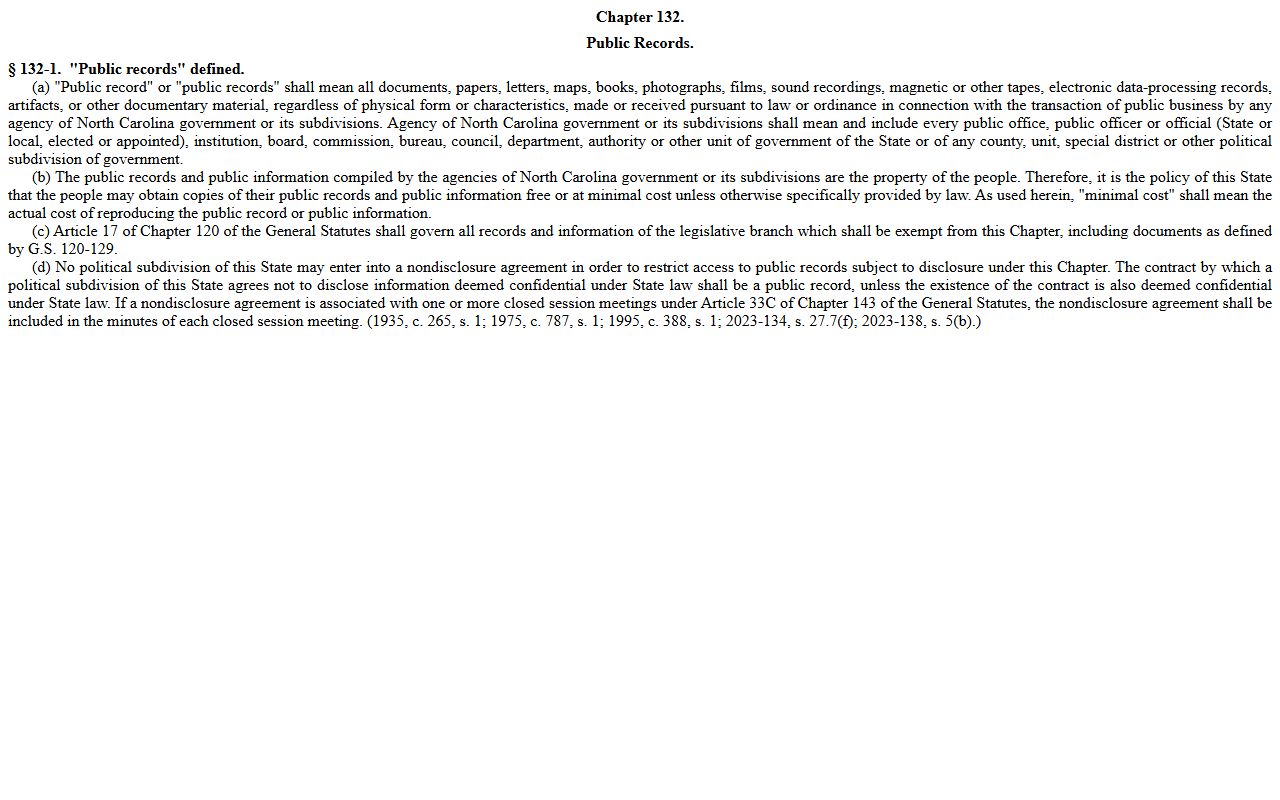
That broad definition is why so many different Durham County public records, from court files to county data, fall under one shared right of access.
Who Is the Custodian of Durham County Public Records
The single most useful idea in North Carolina records law is the custodian. The custodian is the office that holds and controls a record. You request a record from its custodian, not from some central state clearinghouse. For Durham County, this splits public records into three groups, and people mix them up all the time.
Court case records are the first group. Case summaries, hearings, judgments, and many documents are viewable online, but the legal custodian of the actual case file is the Durham County Clerk of Superior Court. The state's eCourts Portal gives public access to case information, yet it is not the official record. For certified or official copies, the request goes to the Clerk. The same is true for older files that never made it online.
The second group is Judicial Branch administrative records. These are policies, statewide data sets, and non-case records held by the North Carolina Administrative Office of the Courts. The NCAOC public records request form handles those. One point trips up many requesters: NCAOC is not the custodian of county case files, marriage licenses, or birth certificates. Sending a request for a Durham divorce file to NCAOC will not work. It must go to the Durham Clerk instead.
The third group is county agency records. The Durham County Sheriff holds jail and arrest data. The Durham County Register of Deeds holds land and vital records. County departments hold budgets, contracts, and operations records. Each is its own custodian under Chapter 132.
Key Statutes:
N.C.G.S. 132-1 - defines public records broadly to include papers, electronic data, photographs, and other materials made or received in public business.
N.C.G.S. 132-6 - requires custodians to allow inspection and provide copies as promptly as possible during normal business hours.
N.C.G.S. 132-6.2 - governs public-records fees and lets agencies charge the actual cost of copies, plus special service charges for extraordinary requests.
N.C.G.S. 132-1.4 - makes certain arrest and incident information public while keeping criminal investigative files generally closed.
Types of Durham County Public Records
The records you can reach in Durham County run across many offices. Court records sit with the Clerk of Superior Court and cover civil, criminal, family, traffic, estate, and special proceeding files. Land and vital records sit with the Register of Deeds. Jail and arrest information sits with the Sheriff. County administrative records sit with the relevant county department. Some of this is open online. Some needs a written request. Some is confidential by law.
Here is a quick map of the main public record groups in the county.
- Court case records - civil suits, criminal cases, traffic, family, estates, and judgments held by the Clerk of Superior Court.
- Land records - deeds, deeds of trust, plats, and assumed names recorded at the Register of Deeds.
- Vital records - birth, death, and marriage certificates issued through the Register of Deeds.
- Law-enforcement records - arrest information and jail data held by the Sheriff's Office.
- County administrative records - budgets, contracts, and department data held by Durham County government.
Court files run deeper than any other group. The Durham County court records page covers how to search cases through the eCourts Portal, and the Clerk of Superior Court page lists the divisions that hold each file type.
Register of Deeds Public Records
The Durham County Register of Deeds is a separate office from the courts, and it is the legal custodian for recorded land, business, and vital records. People often call it the county clerk, but that label is wrong in North Carolina. The Register of Deeds does not hold court case files. It holds deeds, deeds of trust, plats, assumed name filings, and corporate certificates. It also issues and keeps marriage licenses, plus certified copies of birth, death, and marriage records.
Many of these records can be searched online before you ever visit. The office runs a public search tool for real estate documents, and certified copies are available at the counter or by request. Below is the Register of Deeds online public records search entry page.
You can reach the search tool through the Register of Deeds online public records search page, shown below.
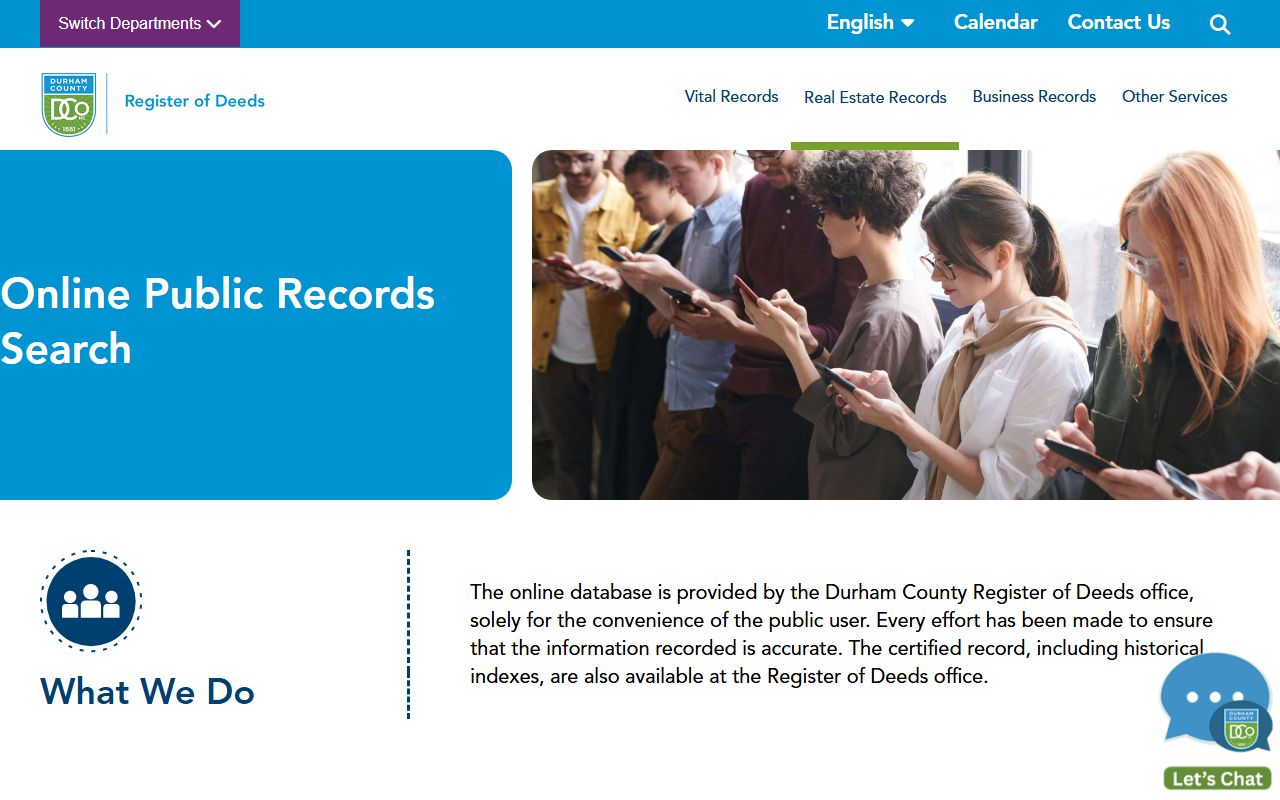
That online index is a fast first stop, though the certified document still comes from the Register of Deeds office itself.
Keep the split clear when a record touches both property and court. A deed, plat, or assumed name belongs to the Register of Deeds. A foreclosure under power of sale, a partition, or a judgment lien may belong to the Clerk's Special Proceedings or Judgments division. A judgment that affects real estate can show up in both systems. When a court judgment touches property title, search both offices. The Register of Deeds page breaks down each record type in more detail.
Law-Enforcement Records and Public Access
Police and Sheriff records follow a special rule. The general public records law applies, but N.C.G.S. 132-1.4 sets criminal investigations and criminal intelligence information apart. Those investigative files are not open to ordinary public inspection. The goal is to protect active cases and the people in them.
Some law-enforcement information stays public, though. Basic arrest facts, such as the name of the person arrested, the charges, and the circumstances of an arrest, are public. Returned arrest warrants, search warrants, indictments, criminal summonses, and nontestimonial identification orders are public court records too, unless a judge has sealed them. So an arrest is on the public side of the line, while the detective's case notes usually are not.
This is why a single person may show up differently across systems. The jail roster shows current custody. The court portal shows charges and case outcomes. An expunged case drops out of public view entirely. For arrest and booking detail, the Durham County arrest records page goes deeper, and the official statute text is shown below.
The criminal-investigation records rule is published on the N.C.G.S. 132-1.4 page, captured below.
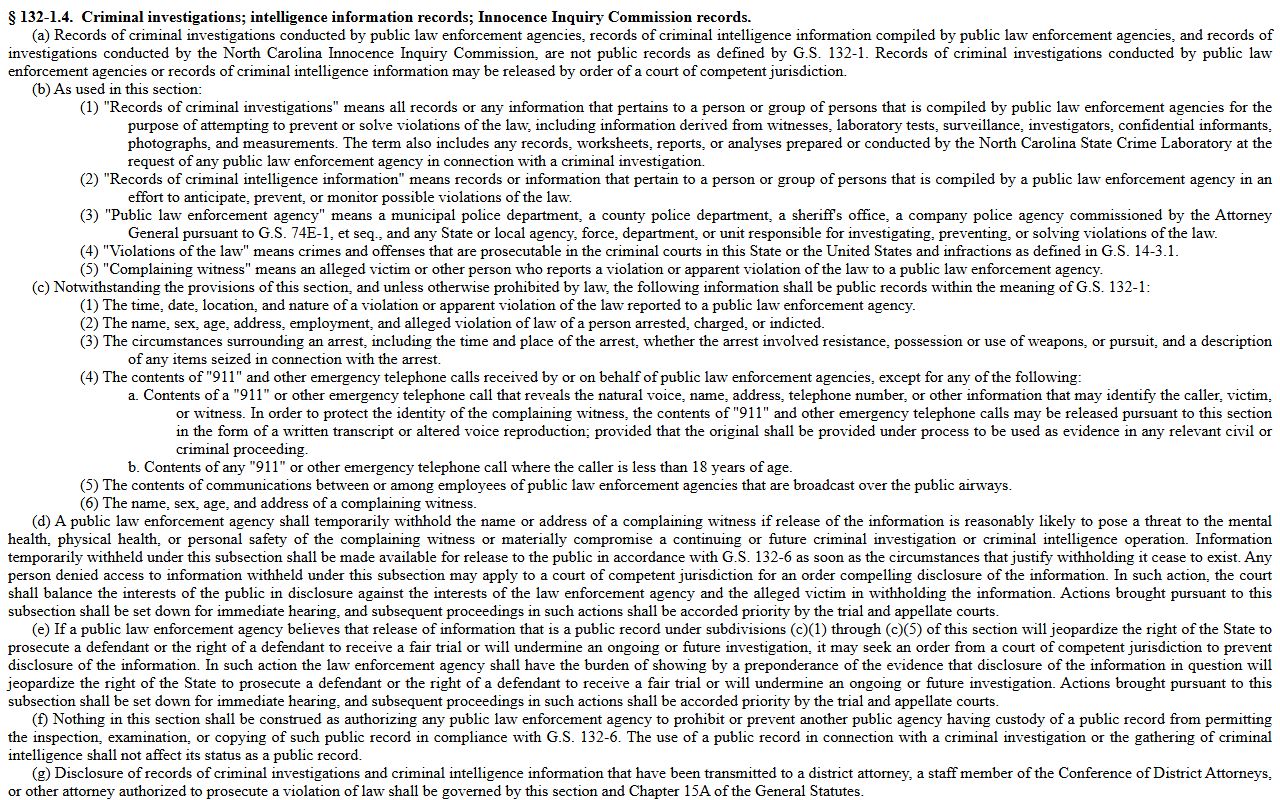
Reading that section first helps set fair expectations before you ask the Sheriff or a clerk for an active case file.
How to File a Durham County Public Records Request
There is no single statewide form for every record. The method depends on the custodian. Court records flow through the eCourts Portal and the Clerk. Judicial Branch administrative records flow through the NCAOC web form. County records flow through the Sheriff or the relevant Durham County department. The steps below work for most requests once you know which office holds the record.
- Identify the custodian. Court case file goes to the Clerk of Superior Court. Land or vital record goes to the Register of Deeds. Jail or arrest data goes to the Sheriff. Statewide court data goes to NCAOC.
- Describe the record clearly. Give a case number, party name, date range, file title, or record type. The more detail you give, the faster the search.
- Submit through the right channel. Use the NCAOC online form for Judicial Branch administrative records, or contact the county office directly for county records.
- Wait for the response. The custodian reviews the request, pulls the record, and removes any confidential parts the law protects.
- Pay any fee and get the record. Some copies and certifications carry a charge set by statute or local rule.
One rule saves a lot of back-and-forth. An agency does not have to create a record that does not already exist. NCAOC repeats this on its request page. You can ask for an existing document, but you cannot make an office build a new report, run a custom search, or answer questions as a public records request. Describe what already exists.
The Judicial Branch also publishes a plain-language overview of the public records law. You can read it on the about North Carolina public records law page before you file.
NCAOC Public Records Request Form
The North Carolina Administrative Office of the Courts uses a short web form for Judicial Branch administrative records. The form is brief on purpose. It collects who you are and what you want, then routes the request. Remember the limit: NCAOC is not the custodian of county case documents, marriage certificates, or birth certificates, and it does not run civil or criminal background searches. Those go to the Clerk, the Register of Deeds, or the Sheriff instead.
The table lists the sections of the NCAOC request form.
| Form Section | What It Collects |
|---|---|
| Section A - Requesting Individual | Your contact information so the office can reach you. |
| Section B - Records Requested | A description of the existing public record you want. |
| Complete | The final submission and confirmation step. |
Keep Section B specific. A vague request slows everything down, and the office may ask you to narrow it before any search begins.
Inspection, Copies, and Response Time
The duty to respond comes from N.C.G.S. 132-6. It tells custodians to permit inspection and provide copies as promptly as possible. The law uses that standard rather than a fixed day count, so there is no single deadline that fits every request. A short, clear request for one document moves fast. A broad request that spans years or needs heavy review takes longer.
You can usually inspect public records during normal business hours at no charge. Copies are a separate matter, and that is where fees come in. The statute also recognizes that some old or fragile records need special handling, so a custodian may set conditions to protect them. Below is the official inspection-and-copying statute.
The inspection and copying rule appears on the N.C.G.S. 132-6 page, shown below.
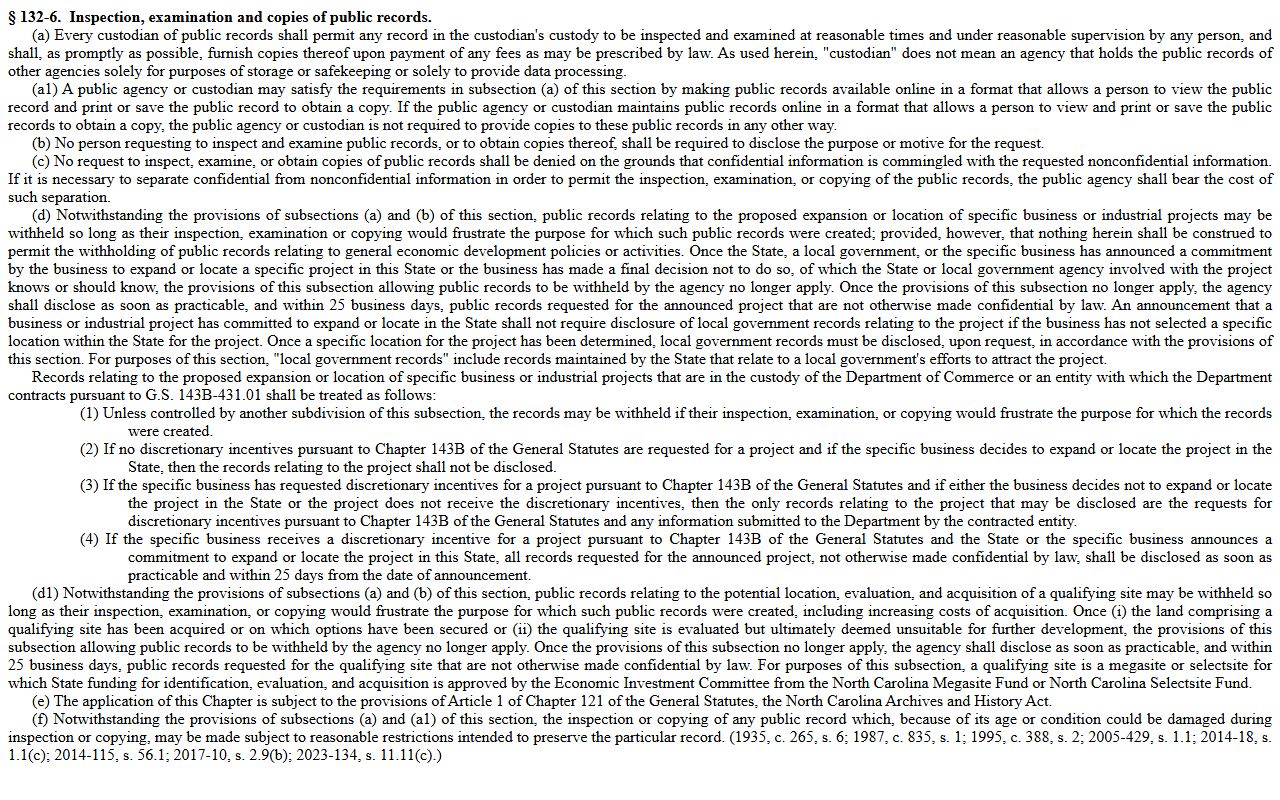
If a request stalls, a short follow-up that points to this section often moves it along.
Durham County Public Records Fees
Fees depend on the office and the record. Under N.C.G.S. 132-6.2, an agency may charge the actual cost of copies and a special service charge when a request takes extraordinary work. The Register of Deeds publishes a clear fee schedule for recorded and vital records. Court copy and certification fees are different. They follow court-cost rules and local clerk practice, not the Register of Deeds table.
The fee statute sits inside the broader Chapter 132 index, where the public records sections are listed together. You can open it through the N.C.G.S. 132-6.2 and Chapter 132 index, shown below.
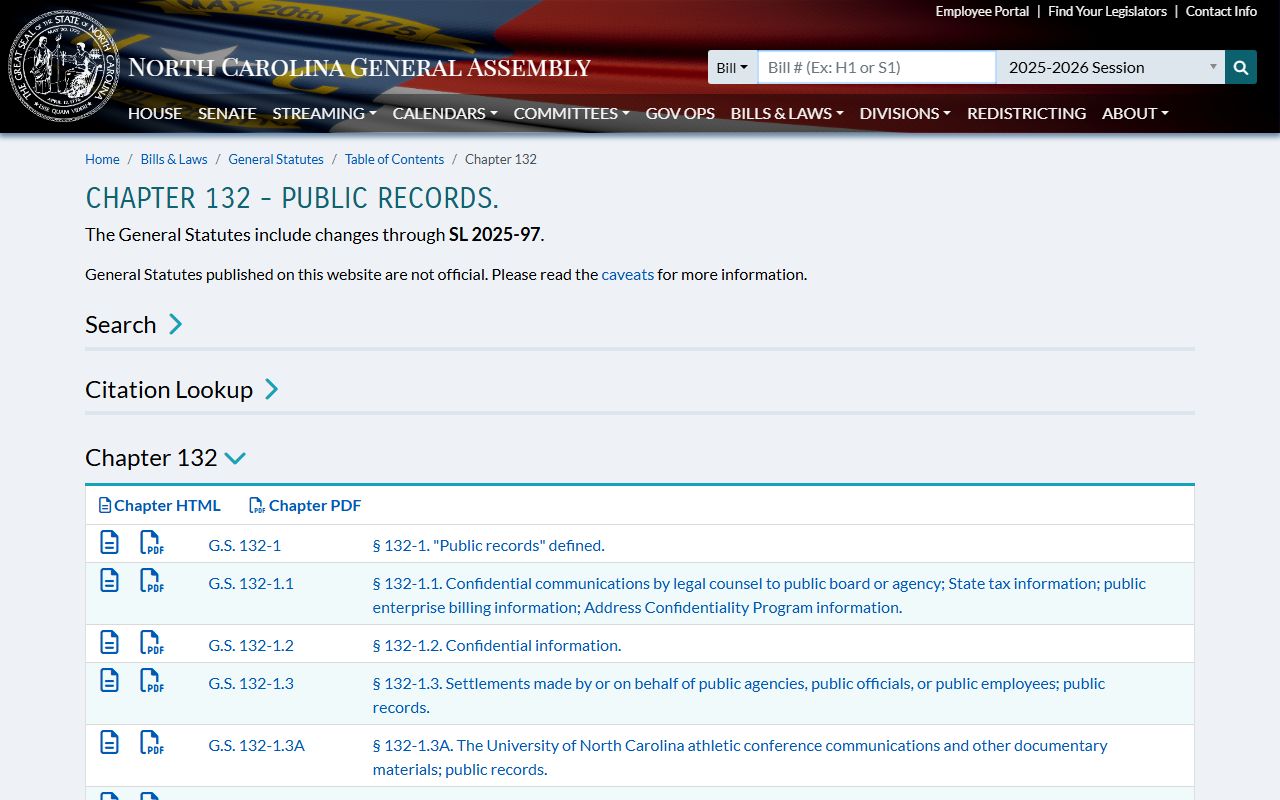
That section is the legal basis for the copy charges Durham County offices apply, and the figures below come from the Register of Deeds schedule.
| Item | Amount |
|---|---|
| Certified copy | $5 first page, $2 each additional page |
| Recording instruments (except deeds of trust/mortgages) | $26 first 15 pages, $4 each additional page |
| Deeds of trust and mortgages | $64 first 35 pages, $4 each additional page |
| Plats | $21 per sheet |
| Marriage license | $60 cash |
For a complete and current list, check the official source directly. The Register of Deeds fee schedule page is shown below.
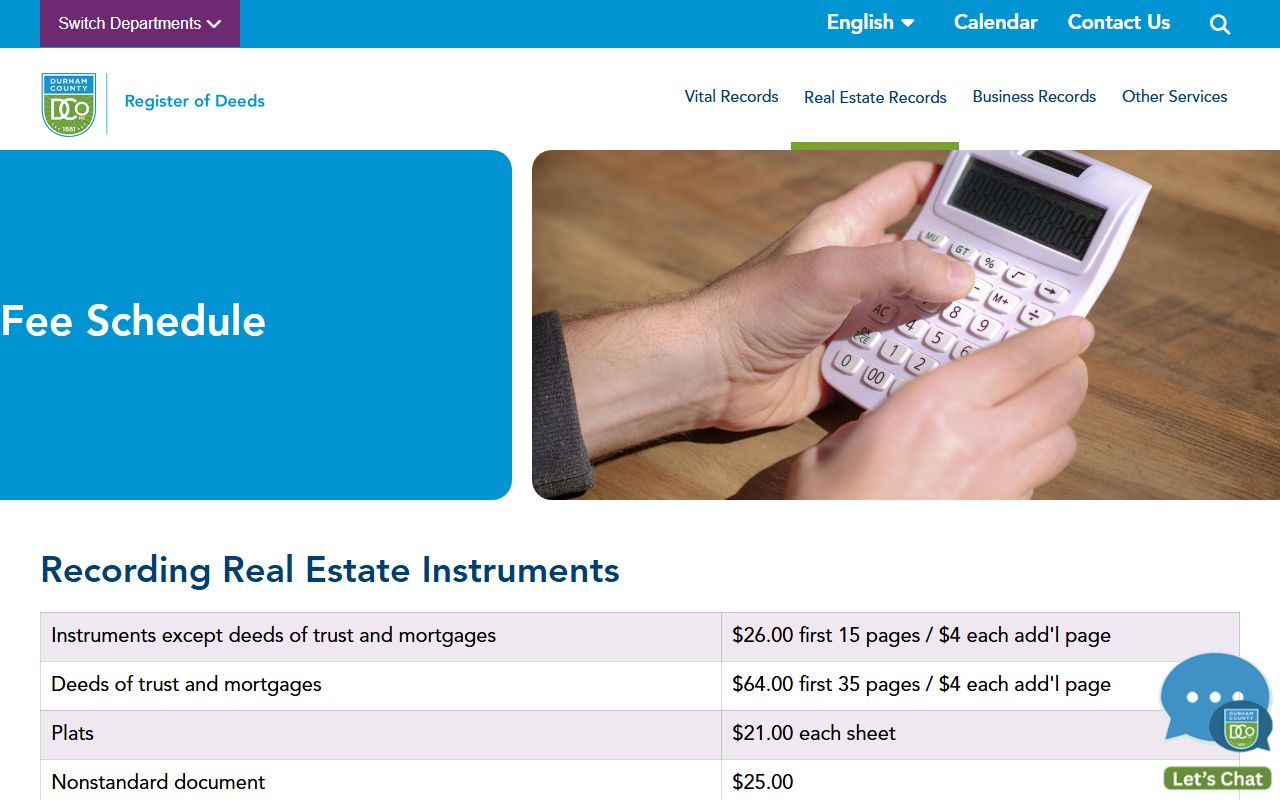
Court fees are not on that page, so a divorce decree copy or a certified court document follows the Clerk's own cost rules instead.
Note: Fees can change, so confirm the current amount with the Register of Deeds or the Clerk before you mail payment or visit the counter.
Records That Are Exempt or Confidential
Not every Durham County record is open. Several statutes pull specific categories out of public view. Juvenile court records are confidential and limited to people the law names. Adoption records are sealed except for the decree and the index entry. Involuntary commitment records are confidential. Active criminal investigative files stay closed under N.C.G.S. 132-1.4, and expunged cases are removed from public sources, including the court portal.
Personal identifiers get protection too. Social Security numbers are not available through the court portal, and a public date of birth may be masked. A custodian may also redact confidential parts of an otherwise public document rather than withhold the whole file. When a record looks sealed, the better path is a court order or a statute that allows release, not a third-party site that may carry stale data. The marriage and divorce records page shows how this plays out for family files.
If a Public Records Request Is Denied
Sometimes a request comes back denied or only partly filled. For a county or law-enforcement record, Chapter 132 gives requesters statutory remedies, including a court action to compel access. The first move is usually less formal. Ask the custodian to explain the denial and point to the statute that allows or blocks the record.
Court records work a little differently. The Clerk of Superior Court is the custodian, and the courts control access to individual case files. If a record is sealed, juvenile, adoption, mental-health, or expunged, release usually needs statutory authority or a judge's order. The Attorney General publishes guidance on the public records law, but the courthouse custodian and the courts decide access to specific court records. When the request is about a court file, start with the Clerk's division that holds it.