
Two Offices for Durham County Marriage and Divorce Records
The split is simple once you see it. Marriage licenses come from the Durham County Register of Deeds. Divorce filings and decrees are court records kept by the Clerk of Superior Court. The Register of Deeds is a county records office, not the county clerk, so do not confuse the two. One issues and records your license. The other holds the case file if a marriage later ends in court.
This matters for a records search. A marriage certificate request goes to the Register of Deeds. A divorce decree request goes to the Clerk. The Clerk also sorts divorce records by age. Recent divorce decrees under 10 years old sit under Civil. Older decrees more than 10 years old move to Judgments. Filing of the divorce itself runs through Family Court. So a single family event can leave a trail across both offices, and the office you visit depends on the exact paper you need.
Both record types are public in most cases. Some details are masked or sealed by law. Still, the everyday marriage license, marriage certificate, and divorce decree are open to people who follow the right steps. For estate matters tied to a death, the Durham County probate records path applies instead, since the Clerk also acts as judge of probate.
Getting a Marriage License in Durham County
Marriage licenses in Durham County are issued by the Register of Deeds. The office issues licenses Monday through Friday, 9:00 a.m. to 4:00 p.m., except holidays, and you need an appointment. Both applicants must be present. You also complete the Online Marriage Application before your scheduled time. The license fee is $60, and it must be paid in cash. Plan for that, since the office expects cash for the license itself.
Eligibility rules are clear. Neither applicant can already be married. The couple must marry within North Carolina. The marriage must happen within 60 days of the license being issued. Each applicant brings valid, unexpired, legible photo identification plus proof of Social Security, and the names must match across documents. Acceptable photo ID includes a driver's license, a state ID card, a passport, or a military ID. Proof of Social Security can be a Social Security card, a legal document showing the full name and full number, a recent W-2 printed within the last two years, an insurance policy, or a bank letter on bank letterhead.
Age adds a step. Applicants who are 18 to 21 must also provide a certified birth certificate. Anyone under 18 should call the office directly at 919-560-0493 before applying, because underage marriage has its own rules. A prior marriage can add a step too. Effective January 1, 2019, an applicant whose last marriage ended within the past 12 months must show proof that it was dissolved. That proof is a certified divorce decree, a certified death certificate, or a court-ordered annulment.
You can read the full marriage license requirements on the Durham County Register of Deeds marriage page, captured below.
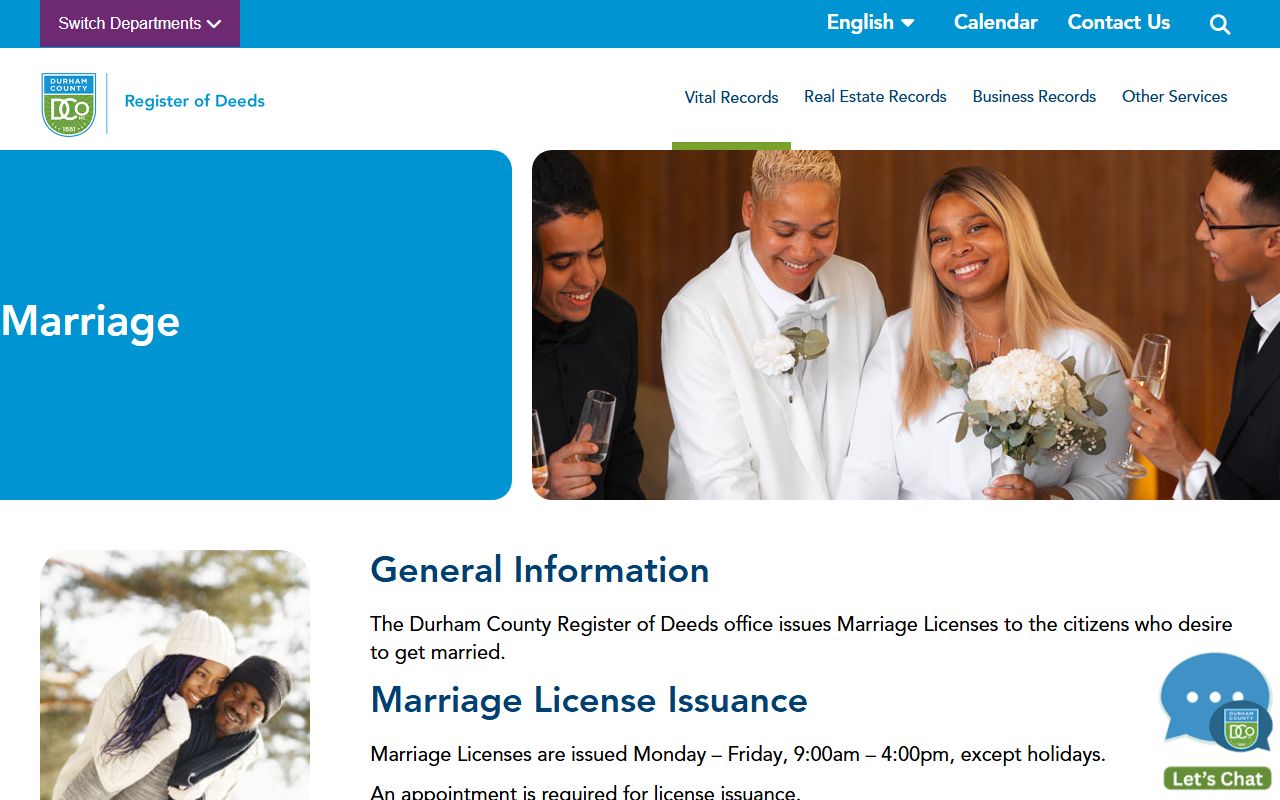
That page lays out the ID list, the appointment rule, and the cash fee in one place before your visit.
How to Apply for a Marriage License
The process moves fast when you prepare first. Gather your documents, confirm both applicants can attend, and finish the online step before the appointment. The order below follows the Register of Deeds workflow for Durham County marriage records.
- Confirm both applicants are eligible, unmarried, marrying in North Carolina, and marrying within 60 days.
- Complete the Online Marriage Application before your appointment.
- Schedule an appointment with the Durham County Register of Deeds.
- Bring valid photo ID and Social Security proof for each applicant, with names that match.
- Bring a certified birth certificate if either applicant is age 18 to 21.
- Bring a certified divorce decree, death certificate, or annulment if a prior marriage ended within 12 months.
- Pay the $60 fee in cash.
After the ceremony, the license must get back to the Register of Deeds for recording. Return it within 60 days. If it is not returned in time, the license expires, and the couple must reapply and pay applicable fees again. A certified copy of the recorded license is the marriage certificate, and it is not mailed to you on its own. You request it separately, which the next sections cover.
Marriage License Application Fields
The Durham County application is built around documents more than typed fields. The Online Marriage Application itself did not expose its individual fields on the static county page, but the items you must produce are well defined. The table lists what each applicant provides and when it is required.
| Field Label | Type | Required | Notes |
|---|---|---|---|
| Online Marriage Application | Web application | Yes, before appointment | Must be completed ahead of the scheduled visit. |
| Applicant 1 identification | Document | Yes | Valid photo ID and proof of Social Security; name must match. |
| Applicant 2 identification | Document | Yes | Same requirements as Applicant 1. |
| Prior marriage dissolution proof | Document | Conditional | Required if a prior marriage ended within the last 12 months. |
| Certified birth certificate | Document | Conditional | Required for applicants age 18 to 21. |
| Appointment | Scheduling form | Yes | An appointment is required for the license to be issued. |
Bring originals or certified copies, not photos on a phone. The office checks that names match across every document you present.
Durham County Marriage Record Fees
Marriage fees are set by the Register of Deeds and are separate from any court cost. The license is the big one at $60 cash. The other fees cover certified copies and corrections. The table gathers the figures the Durham County office publishes.
| Item | Amount |
|---|---|
| Marriage license | $60 cash |
| Marriage license certified copy | $10 |
| Delayed marriage certificate with one certified copy | $30 |
| Application or license correction with one certified copy | $20 |
The certified copy fee is what most people pay after the wedding. That copy is the legal marriage certificate, useful for a name change, a benefits claim, or proof of marriage. Divorce decree fees are court fees, not Register of Deeds fees, so those come from the Clerk and follow state court-cost rules.
Note: The marriage license fee is cash only, so bring exact cash, and confirm certified copy amounts with the office before you mail a request.
Requesting a Durham County Marriage Certificate
Once a license is recorded, a certified copy of it becomes the marriage certificate. The Register of Deeds does not send that copy on its own. You ask for it, and you pay the fee. There are three ways to make the request: in person at the office, by mail using the request form, or by a signed letter of request.
The Register of Deeds also handles birth and death certificates and other vital records for Durham County. The vital records page sets out certified copy rules and points to the state NCDAVE system for some records.
You can review the certified copy options on the Durham County vital records page, shown below.
That page is the right starting point when you need a marriage certificate rather than the original license.
Filing for Divorce in Durham County
Divorce is a court case, so it starts with the Clerk of Superior Court, not the Register of Deeds. In Durham County, divorce filing runs through Family Court. People who file without a lawyer can use the Durham County Pro Se Absolute Divorce Packet, which the county Judicial Branch page links for self-represented litigants. The packet walks a filer through the forms an absolute divorce needs.
There is also a guided online tool. eCourts Guide & File is a free service that helps prepare court documents for certain case types. If a divorce workflow fits, it can build the filing for you and connect to the state's electronic filing concepts. After filing, you serve the other party under North Carolina law, then track hearings and case events through the portal or by contacting the Clerk.
The basic divorce path looks like this.
- Review the Durham County Pro Se Absolute Divorce Packet if you are self-represented.
- File your divorce documents with the Clerk of Superior Court through Family Court.
- Use eCourts Guide & File if an available divorce workflow fits the case.
- Serve the opposing party as North Carolina law requires.
- Track hearings and case events through the portal or the Clerk.
The Durham County Clerk of Superior Court page covers filing divisions, hours, and request methods in more depth.
Searching Durham County Divorce Records
Divorce case information may be searchable online unless a court has restricted it. The tool is the North Carolina eCourts Portal, the same statewide system used for other court records. You can look up a case by party name, by case number, or by other supported fields. The portal shows public case information, but it is not the official record, so plan a second step for any certified document.
Where the decree lives depends on its age. The Durham Clerk lists divorce decrees less than 10 years old under Civil. Decrees more than 10 years old move to Judgments. The original divorce filing ties to Family Court. So if a search returns a hit but you need the paper, you ask the right Clerk division based on how old the case is.
You can start a divorce case search on the North Carolina eCourts Portal. A blank result does not always mean no record. It can mean a sealed file, a name spelled a different way, or a case in another county. The Durham County court records page explains the portal's search rules in detail.
Certified Copies of a Divorce Decree
A certified copy is the version courts and agencies accept. Online portal copies are public, but they are not certified, and they are not the official record. For a certified divorce decree, you go to the Clerk of Superior Court. Which division you ask depends on the decree's age. Request a recent decree from Civil if it is less than 10 years old. Request an older decree from Judgments if it is more than 10 years old.
Bring the case number if you have it, since that speeds the search. If you only have names, the Clerk can still look, but it takes longer. The Clerk's staff can explain the request process, though they cannot give legal advice about what the decree means for you. Court copy and certification fees follow state court-cost rules and local clerk practice, so confirm the current amount before you pay.
Restricted Marriage and Divorce Materials
Most marriage and divorce records are open, but a few related files are not. Some military discharge records recorded with the Register of Deeds have restricted access by statute. The Durham office records DD-214 military discharge documents and limits who can get a copy. That protects the privacy of veterans and their families.
The military records page sets out the recording and access rules for those documents.
You can read the access limits on the Durham County military records page, shown below.
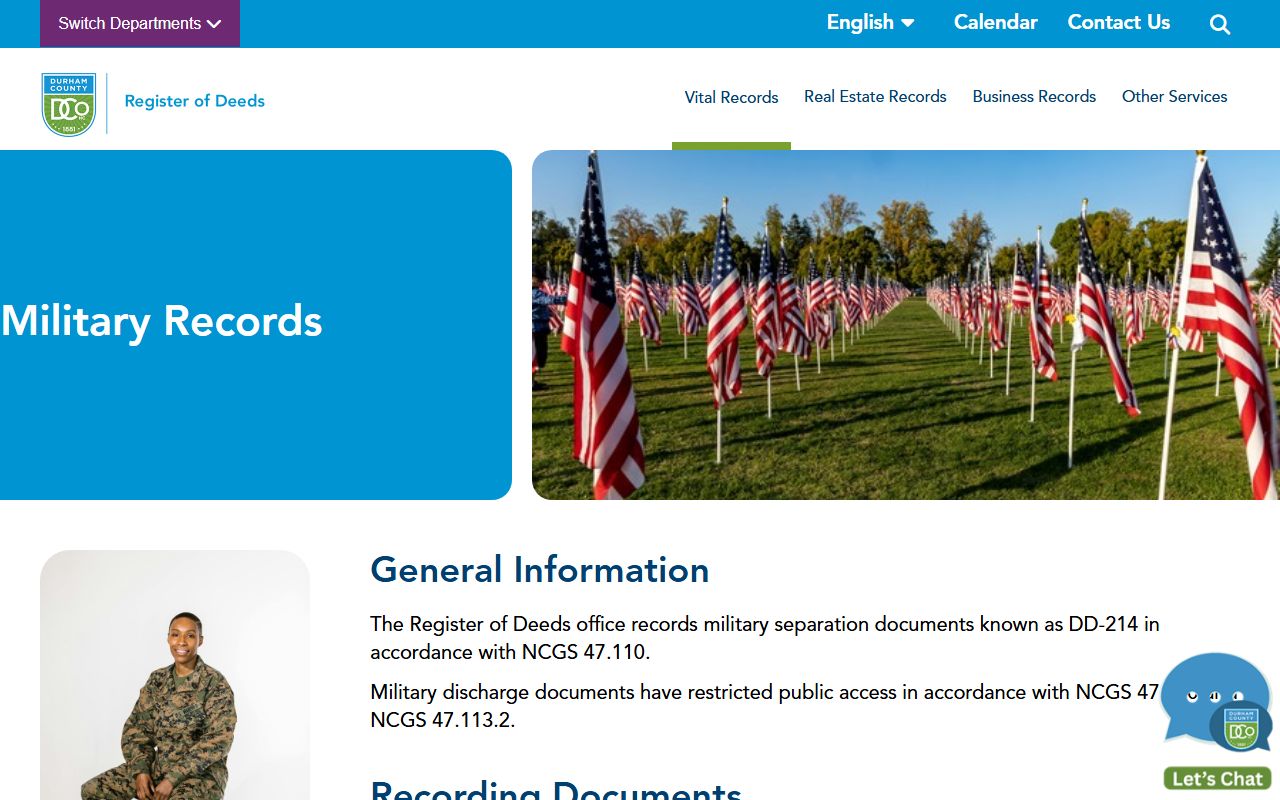
On the divorce side, a court can seal parts of a file, and juvenile or domestic violence details may be shielded. When in doubt, ask the Clerk's division that holds the file rather than relying on a third-party site.
Related Durham County Records
A divorce or name change can ripple into other records. After a divorce, a new driver record name may need updating with the state DMV. Driver and driving records are kept by the North Carolina Division of Motor Vehicles, not by the county, and they are a separate file from any court record. That distinction matters if you are gathering documents after a name change.
The NCDMV explains how to request a driving record on its official page.
You can review the request options on the NCDMV driving records page, shown below.
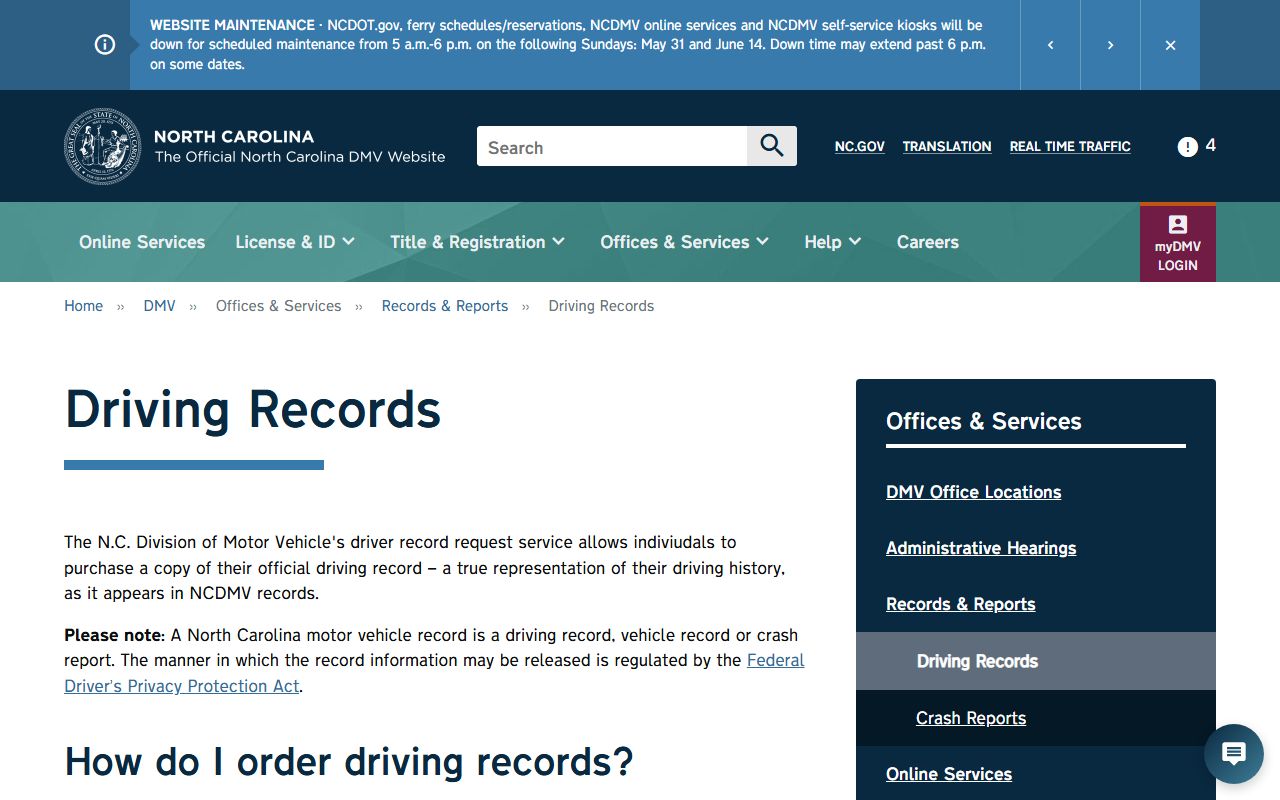
For estate filings after a spouse's death, see Durham County probate records. For open-records requests and the broader access framework, see Durham County public records. The county courthouse contact and hours appear on the North Carolina courts Durham County page.